

 By Dr. Nelson Echebiri
 Poultry Record-Keeping Is Not Enough: Meet the Aviarai Advantage
Beyond Record Keeping: Why Aviarai Combines Poultry Farm Management with AI-Powered Decision Intelligence
Executive Summary
- The Problem: Traditional poultry management software records and organizes historical data, but farmers still have to interpret complex biological and economic patterns.
- The Innovation: Aviarai combines poultry farm management with dynamic, flock-specific Aviarai Smart Feed recommendations, HDEP projections, and decision support.
- The Evidence: In a seven-consecutive-day field observation of approximately 14,000 ISA Brown layers in Pen 3 Youngman’s House, Aviarai recommended 109–112 g/bird/day compared with a static 115 g/bird/day global reference. Recorded HDEP averaged approximately 79.61%, versus an average Aviarai projection of approximately 80.14%, with a mean absolute daily difference of approximately 0.62% points. Smart Feed’s cumulative calculated feed-cost savings increased by ₦217,392.22 during the same seven-day window.
The evidence is first-party observational product evidence from one commercial flock. It is not a controlled feeding trial and does not establish causation. Its value is that it documents the full decision-intelligence chain: a flock-specific recommendation, a production projection, a recorded outcome, and an economic comparison against a defined static feeding reference.
The Baseline: Aviarai Smart Feed Started at ₦0.00
Smart Feed began operating for Pen 3 Youngman’s House on July 8, 2026. On that date, Aviarai recommended 115 grams of feed per bird per day, exactly the same feeding level as the global reference. The platform therefore displayed ₦0.00 in calculated savings. Aviarai projected 83.00% HDEP, and the flock subsequently recorded 83.52% HDEP.
This starting point matters because Smart Feed’s savings metric is based on a counterfactual: the feed quantity and associated cost under Aviarai’s flock-specific recommendations compared with the feed quantity and cost that would have resulted from following the static global feeding guideline.
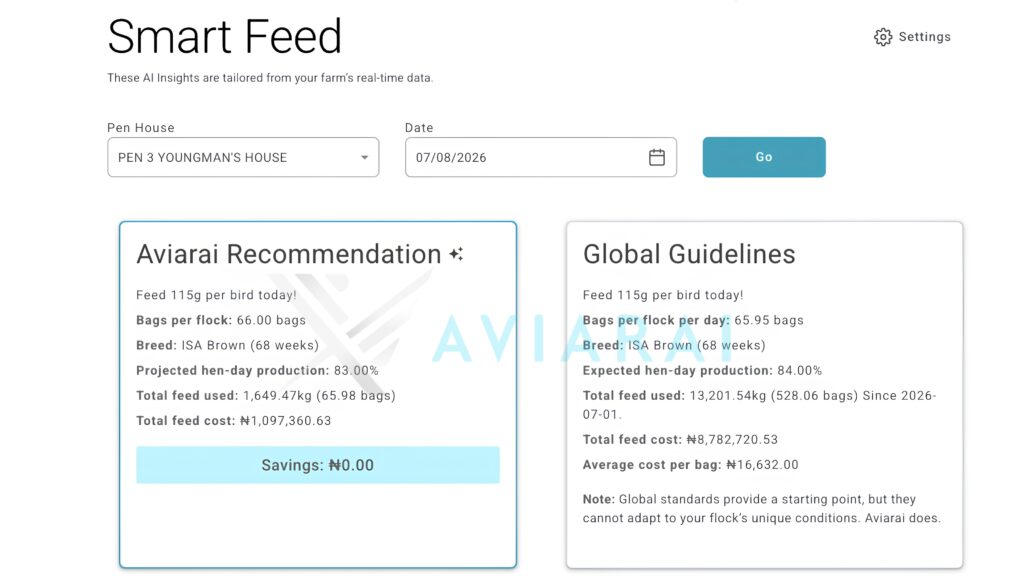
Figure 1. Smart Feed baseline on July 8, 2026: 115 g/bird/day under both Aviarai and the global reference, with ₦0.00 in displayed calculated savings.

Figure 2. Recorded outcome on July 8, 2026: Pen 3 produced 11,970 eggs and recorded 83.52% HDEP.
Field Evidence: Seven Consecutive Days
The principal field observation covers July 31 through August 6, 2026. For each of the seven consecutive dates, the Aviarai Smart Feed recommendation and projected HDEP are paired with the corresponding production record for the same flock.
| Date | Smart Feed (g/bird/day) |
Global ref. (g/bird/day) |
Aviarai Projected HDEP |
Actual HDEP | Abs. diff. | Cumulative savings |
|---|---|---|---|---|---|---|
| Jul 31 | 112 | 115 | 81.00% | 79.33% | 1.67 pp | ₦455,066.10 |
| Aug 1 | 112 | 115 | 80.00% | 79.56% | 0.44 pp | ₦483,444.95 |
| Aug 2 | 112 | 115 | 80.00% | 79.36% | 0.64 pp | ₦511,815.82 |
| Aug 3 | 112 | 115 | 80.00% | 79.83% | 0.17 pp | ₦540,182.69 |
| Aug 4 | 112 | 115 | 80.00% | 79.84% | 0.16 pp | ₦568,535.59 |
| Aug 5 | 110 | 115 | 80.00% | 80.29% | 0.29 pp | ₦615,780.45 |
| Aug 6 | 109 | 115 | 80.00% | 79.05% | 0.95 pp | ₦672,458.32 |
Table 1. Seven consecutive observations for Pen 3 Youngman’s House, July 31–August 6, 2026. Average actual HDEP: 79.61%. Average Aviarai projected HDEP: 80.14%. Mean absolute daily difference: approximately 0.62 percentage points.
Across the seven-day window, the Aviarai Smart Feed recommendation moved from 112 g/bird/day to 109 g/bird/day while the global reference remained at 115 g/bird/day. Actual HDEP remained within a relatively narrow range of 79.05% to 80.29%. The observed production pattern does not prove that the lower feed recommendations caused the recorded outcomes, but it allows the recommendation and prediction to be checked against what the flock actually produced.
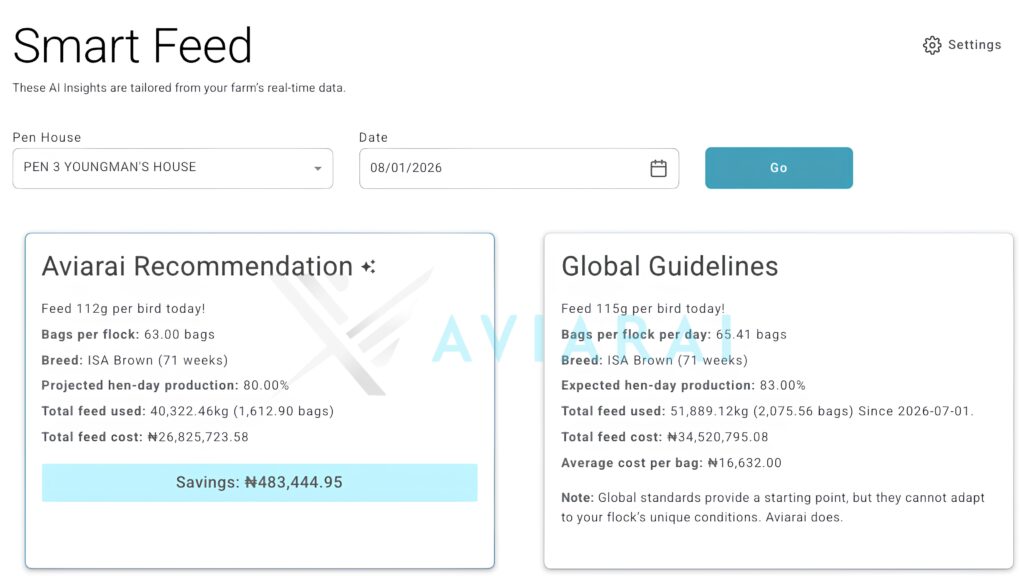
Figure 3. Smart Feed on August 1, 2026: Aviarai recommended 112 g/bird/day versus the 115 g/bird/day global reference and projected 80.00% HDEP. The corresponding recorded HDEP was 79.56%.
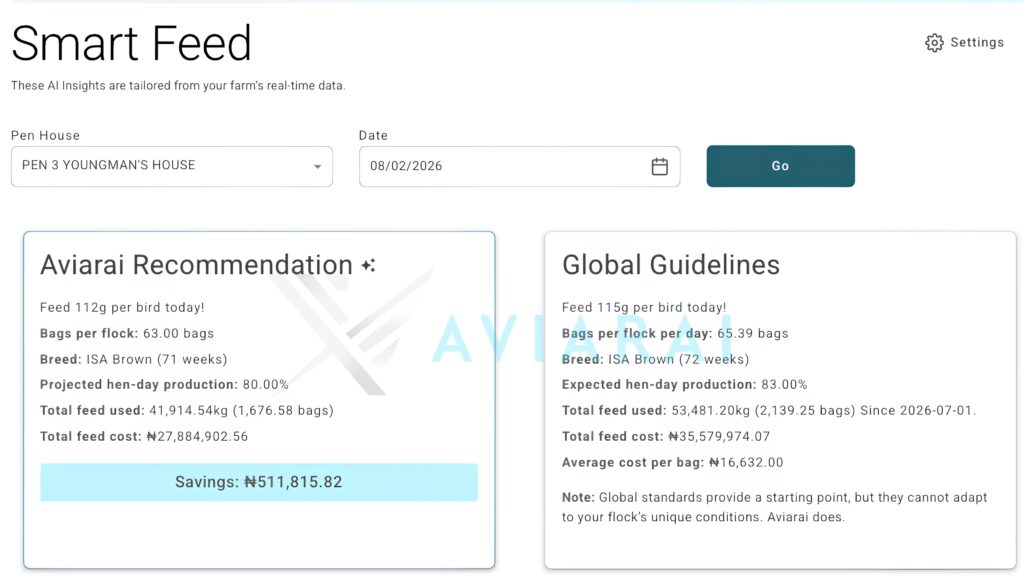
Figure 4. Smart Feed on August 2, 2026: Aviarai recommended 112 g/bird/day versus the 115 g/bird/day global reference and projected 80.00% HDEP. The corresponding recorded HDEP was 79.36%.
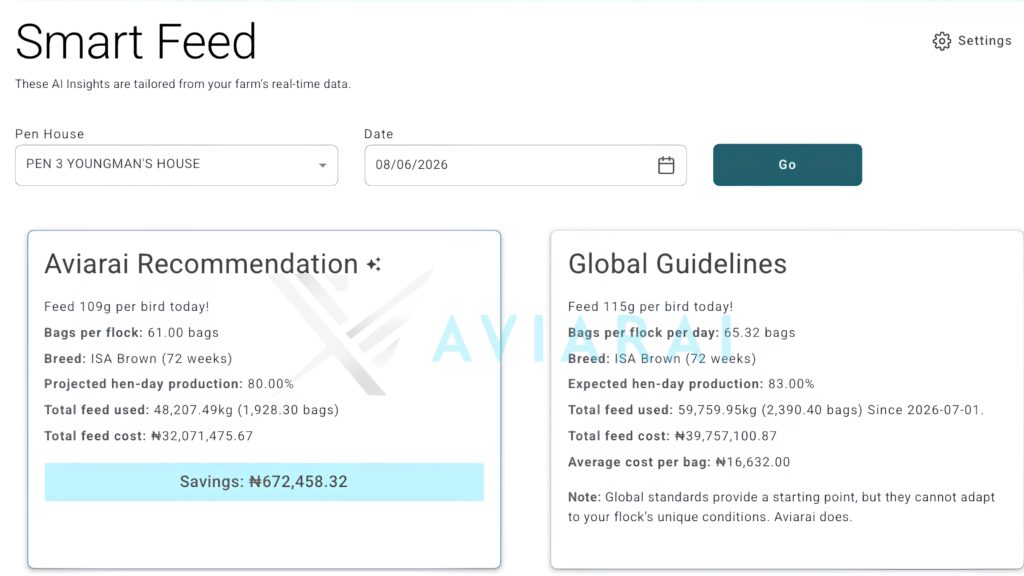
Figure 5. By August 6, Aviarai recommended 109 g/bird/day versus the static 115 g/bird/day reference and displayed ₦672,458.32 in cumulative calculated feed-cost savings.
Methodology and Interpretation
Observation window:
Seven consecutive days, July 31 through August 6, 2026, for Pen 3 Youngman’s House. For each date, the analysis pairs the Aviarai Smart Feed recommendation and projected hen-day egg production with the corresponding recorded HDEP for the same flock.
Projection comparison:
Average projected HDEP across the seven days was approximately 80.14%, compared with average recorded HDEP of approximately 79.61%. The mean absolute daily difference between projected and recorded HDEP was approximately 0.62 percentage points; daily absolute differences ranged from 0.16 to 1.67 percentage points.
Savings comparison:
Smart Feed compares the feed quantity and associated feed cost under Aviarai’s flock-specific recommendation with the feed quantity and cost that would have resulted from following the static global feeding guideline. The displayed savings figure accumulates this calculated feed-cost difference over time. Smart Feed began at ₦0.00 on July 8 when both feeding scenarios were 115 g/bird/day. The displayed cumulative calculated savings were ₦455,066.10 on July 31 and ₦672,458.32 on August 6, an increase of ₦217,392.22 during the seven-day observation window.
Economic interpretation:
These figures represent calculated feed-cost avoidance relative to the static global feeding reference. They are not additional revenue or audited net profit. Realized farm economics also depend on actual feed delivered, egg output and prices, mortality, labor, health costs, and other operating conditions.
Limitations:
This is first-party observational product evidence from one flock, not a randomized or controlled feeding trial. It does not establish that lower feed recommendations caused the observed production, and it should not be generalized as formal model validation. Broader validation across farms, flock ages, seasons, housing systems, and production conditions is required.
What Is Poultry Farm Management?
Poultry farm management software primarily helps farmers answer one fundamental question: What is happening on my farm?
Commercial poultry farms generate large amounts of operational data every day. For a layer farm, this can include egg production, feed consumption, mortality, culling, flock population, body weight, vaccination and medication, feed and raw-material inventory, egg inventory, sales and expenses, farm tasks, environmental conditions, production KPIs, and flock performance history.
Digitizing this information is enormously valuable. Instead of operational information being fragmented across notebooks, spreadsheets, WhatsApp messages, paper forms, and the memories of farm employees, a poultry management system creates a structured digital record of the farm.
However, collecting better records is only the beginning. As we explored in Farm Records Are Not the Problem. What You Do With Them Is, the greater opportunity lies in turning those records into information that improves actual farm decisions. The farmer can determine how many eggs were produced yesterday, how much feed was consumed, how many birds died, what inventory remains, and how different flocks are performing. That creates visibility.
But visibility is not the same thing as intelligence. Knowing what happened does not necessarily tell a farmer what decision to make next. The value of farm data is not simply in collecting it. Research on the Value of Information (VoI) in precision livestock farming provides a framework connecting data processing, decision-making, and the resulting outcomes. ¹ For poultry farmers, that distinction matters: records tell you what happened; decision intelligence helps determine what to do next.
What Is Poultry Decision Intelligence?
Poultry Decision Intelligence is the use of structured farm data, poultry production science, analytics, machine learning, artificial intelligence, historical performance, and contextual information to support better poultry production and operational decisions.
Traditional farm management focuses primarily on capturing and reporting information. Decision intelligence goes further by asking what that information means in context.
Instead of stopping at “Egg production today is 79.83%,” a decision-intelligence system asks: “Is 79.83% appropriate for this flock, at this age, on this farm, under these conditions?”
Then the questions become more sophisticated:
- Is production declining or improving?
- How does current production compare with the flock’s recent performance?
- How does it compare with an appropriate breed or production benchmark?
- Did feed intake change before production changed?
- Is body weight deviating from expectation? Is mortality behaving unusually?
- Are environmental conditions creating production pressure?
- Has a similar pattern occurred previously?
- What might happen if the current trajectory continues? What should the farmer investigate first?
These are not simply data-management questions. They are decision questions. And commercial poultry farmers make hundreds of them.
Record-Keeping Software Answers What Happened. Farmers Need More.
Imagine that a layer farm’s records show egg production has declined for four consecutive days, feed intake has changed, mortality remains relatively stable, and body weight is slightly below target.
A traditional management system has done something useful if it accurately captures, calculates, and displays those variables. But the farmer’s real work has just started.
- Is the decline significant or normal for the flock’s age?
- Did feed intake begin changing before production declined?
- Is body weight becoming a production constraint?
- Are environmental conditions contributing?
- Has this flock experienced the pattern before?
- Does the situation require immediate investigation?
- If the trajectory continues, what might production look like next week?
Farm management provides visibility. Decision intelligence adds context, interpretation, prediction, and decision support.
The Four Levels of Poultry Farm Intelligence
Level 1: Descriptive Intelligence
- What happened?
Examples include eggs produced, feed consumed, mortalities, current flock population, hen-day egg production, feed conversion ratio, and feed inventory. This is the foundation. Without reliable descriptive data, the higher levels become much more difficult. But it is the floor of digital poultry farming, not the ceiling.
Level 2: Diagnostic Intelligence
- Why might it be happening?
At this level, data points stop being treated as isolated numbers. The system begins looking for relationships, trends, deviations, and unusual patterns. Egg production may be declining while feed intake falls; mortality may move above the flock’s recent baseline; body weight may deviate from the expected trajectory. Importantly, identifying relationships does not automatically establish causation. Decision intelligence should help narrow the farmer’s investigation, not manufacture certainty where none exists.
Level 3: Predictive Intelligence
- What is likely to happen next?
Historical records become more valuable when they can inform future expectations. Depending on available data and model capability, predictive poultry intelligence can support expected egg production, feed requirements, mortality risk, expected body weight, production deviations, peak-production expectations, disease-risk signals, flock-performance forecasts, and economically appropriate depopulation timing.
Level 4: Prescriptive Intelligence
- What should the farmer investigate or consider doing next?
Prediction tells a farmer that something may happen. Prescriptive intelligence attempts to make that information useful to the decision itself. If feed consumption moves outside the range associated with expected production, if inventory could run out, or if mortality begins deviating meaningfully, the farmer can be prompted to investigate earlier. This is where data begins influencing decisions, and at commercial scale better decisions can materially influence productivity, cost, and profitability.

Mortality: Why Context Changes Everything
Suppose a farmer sees: Mortality today: 15 birds. Is that good or bad? The number alone cannot answer the question.
Fifteen mortalities in a flock of 500 birds would be alarming. Fifteen in a flock of tens of thousands requires a very different interpretation.
But even flock size is not sufficient. What is the mortality rate? What is the flock’s age? What has mortality looked like during the previous seven days? Is it accelerating? Is the pattern unusual relative to the farm’s history? What is happening to feed and water intake? Has egg production changed? What relevant disease or environmental pressures exist? How does the farm compare with appropriate benchmarks?
Intelligence requires context. This is why Aviarai’s Farm Performance capability goes beyond displaying a mortality count. It allows mortality to be viewed as a rate, examined over time, and interpreted alongside regional performance benchmarking.
Recording tells you that birds died. Context helps you determine whether the pattern deserves attention.
Why Local Intelligence Matters in African Poultry Farming
Intelligence must understand where the farm operates. Breed standards and global production guidelines are valuable reference points. But chickens do not live inside guideline manuals. They live on farms.
A flock operates under a particular housing system, climate, feeding program, management regime, disease environment, infrastructure system, and economic reality.
Many commercial poultry farms across Africa contend with volatile feed and raw-material prices, heat stress and climate variability, open-sided or naturally ventilated poultry houses, infrastructure and energy constraints, disease pressure, uneven access to veterinary and technical support, differences in locally available feed ingredients, fragmented historical farm data, rapidly changing egg markets, and limited access to locally relevant performance benchmarks.
Feed management makes this especially important in Africa, where seemingly small inefficiencies can become enormous when multiplied across millions of birds. We explored the scale of that problem in This One Error Is Costing African Poultry Farmers Billions.
This does not make global poultry knowledge irrelevant. It makes contextualization essential. A breed guideline might answer: “How should this breed generally perform?” Local decision intelligence ultimately seeks to answer: “How is this flock performing on this farm, in this location, at this age, under these conditions?”
Hyperlocal Data Is the Foundation of Local Intelligence
Artificial intelligence cannot compensate indefinitely for poor underlying data. Better intelligence begins with better records.
Every daily flock entry, egg-production record, feed entry, mortality, body-weight measurement, vaccination, inventory transaction, environmental reading, and production cycle creates another observation.
Individually, these records may appear routine. Collectively, they create a digital representation of how the farm behaves.
Over time, the question can evolve from “How do commercial layers generally perform?” toward “How does this flock normally perform on this farm?” And, as sufficient anonymized and appropriately structured data become available: “How does this farm compare with relevant farms operating under similar conditions?” Farm management therefore becomes the data infrastructure for poultry intelligence.
Why Farm Management and AI Belong in the Same Platform
Artificial intelligence without reliable local farm data has limited value. But farm data without interpretation can leave farmers staring at dashboards trying to determine what the numbers mean.
The two sides reinforce each other.
Farm Operations → Data Collection → Performance Measurement → Context & Analysis → Prediction → Recommendation → Farmer Decision → Farm Operations
AI Should Not Replace the Farmer
Artificial intelligence should not remove farmers, veterinarians, nutritionists, or production managers from the decision-making process.
A poultry farm is a biological system. Multiple variables interact simultaneously. Correlation does not automatically establish causation. Predictions contain uncertainty. A recommendation produced from data should not automatically become an action simply because an algorithm generated it.
Experienced human judgment remains essential. Aviarai’s role is to improve the information available when that judgment is required. Traditional record keeping says: “Here are your numbers.” Decision intelligence moves toward: “Here are your numbers. Here is what is changing. Here is what appears unusual. Here is what may happen next. And here are the areas you should investigate or consider.”
AI informs. The farmer decides.
From Digital Poultry Farming to Intelligent Poultry Farming
Replacing a notebook with an application is digitization. It is valuable. But it should not be the final destination.
The larger opportunity is a poultry operation where feed records inform feeding decisions; mortality data contributes to earlier detection of abnormal patterns; environmental data helps identify production risk; production history improves forecasting; flock history creates increasingly relevant benchmarks; inventory data helps prevent shortages; financial information reveals the economic consequences of operational decisions; and thousands of ordinary data points become a clearer understanding of what is happening inside the farm.
This connection between biological performance and financial performance is critical. A flock can appear productive while hidden inefficiencies quietly erode margins. If that sounds familiar, see Why Is My Commercial Poultry Layer Farm Losing Money?. That is the transition from digital poultry farm management to intelligent poultry farming.
Aviarai: Poultry Farm Management + Decision Intelligence
Aviarai is built around a simple principle: Poultry farmers do not need another place to enter numbers. They need more intelligence from the numbers they already generate.
Farm management provides the operational foundation. It captures and organizes production, flock, feed, health, inventory, financial, environmental, and performance information.
Decision intelligence builds on that foundation. It transforms structured records into increasingly useful trends, deviations, benchmarks, alerts, predictions, recommendations, and decision support.
Together, they create an AI-powered poultry farm management and decision intelligence platform built around the realities of commercial poultry farming.
This combination is the foundation of Aviarai’s broader vision for intelligent poultry farming. For a deeper look at the platform and why we built it, read Introducing Aviarai: Africa’s First Poultry Decision Intelligence Platform.
Ultimately, Aviarai is designed to help farmers answer four increasingly valuable questions:
- What happened?
- Why might it be happening?
- What could happen next?
- What should I investigate or consider doing about it?
Stop Recording Yesterday. Start Deciding Tomorrow.
The future of poultry technology is not simply about collecting more data. Commercial farms already generate enormous amounts of it.
The opportunity is to make that data more useful: to identify meaningful changes earlier, put individual numbers into context, anticipate potential outcomes, understand the economic consequences of small operational decisions, and give farmers better information when a decision needs to be made.
Aviarai Smart Feed example illustrates what that future can look like.
- 14,000+ birds in the documented flock
- 79.05% – 80.29% observed HDEP across seven consecutive days
- 109–112 g/bird/day Aviarai feed recommendations across the seven-day observation window
- 115 g/bird/day global reference guideline throughout the seven-day observation window
- 3–6 g difference per bird depending on date
- Platform-displayed cumulative calculated feed-cost savings rose from ₦455,066.10 on July 31 to ₦672,458.32 on August 6, an increase of ₦217,392.22 during the seven-day observation window
The important story is not simply a few grams. It is that the recommendation changed with the context of a specific flock while the reference guideline remained static, and that the platform paired those recommendations with production projections that can be checked against recorded outcomes.
That is where poultry software begins moving beyond records. That is where data begins becoming intelligence. And that is where intelligence can begin improving decisions.
Management gives farmers control of their data. Decision intelligence helps them extract value from it. Local intelligence makes that value relevant to the environment in which they actually farm.
Because the goal is not simply to record the farm.
The goal is to understand it.
References
- Rojo-Gimeno, C., et al. (2019). Assessment of the value of information of precision livestock farming: A conceptual framework. NJAS – Wageningen Journal of Life Sciences, 90–91, 100311.
- ISA. ISA Brown Commercial Management Guide, North American Version, ISA Brown Production Table, p. 70. Feed intake is listed at 115 g/bird/day from 28 weeks of age. ISA Brown Commercial Management Guide.
The future of poultry farm management is not better record-keeping. It is turning those records into better decisions. Are you ready to move beyond basic records? Discover how the Aviarai Smart Feed works for your flock.