
What Is Poultry Decision Intelligence?
1. What Is Poultry Decision Intelligence?
Poultry Decision Intelligence is the use of poultry farm data, artificial intelligence, predictive analytics, and farm-specific context to help poultry farmers understand flock performance, anticipate future outcomes, and make better-informed production and economic decisions.
It extends beyond digital record-keeping and historical reporting by transforming routine operational farm data into actionable intelligence, including recommendations, forecasts, alerts, benchmarks, and performance insights that help farmers determine what to do next.
Poultry farms generate operational data every day through records such as feed intake, egg production, mortality, flock weight, inventory, vaccination, sales, expenses, and other production activities. Traditional record-keeping systems can help farmers capture, organize, and visualize this information. Poultry Decision Intelligence goes further by analyzing the data within the context of the individual farm and flock to generate intelligence that can support future decisions.
The distinction can be summarized simply:
Traditional poultry record-keeping: Farm data → records → reports
Poultry Decision Intelligence: Farm data → intelligence → decisions
This does not make record-keeping less important. In fact, reliable farm records provide the data foundation that makes Poultry Decision Intelligence possible. The difference is what happens after the data is collected.
Instead of only answering questions such as “What happened on my farm?”, Poultry Decision Intelligence can help farmers address more decision-oriented questions:
- What is happening with this flock?
- Is its performance changing?
- What might happen next?
- Is something unusual developing?
- How does this flock compare with an appropriate benchmark?
- What action may need to be considered?
In this way, Poultry Decision Intelligence creates an intelligence layer between farm data and farmer decision-making. Thereby helping transform everyday poultry records from a historical account of farm operations into a resource for making better-informed production and economic decisions.
2. Why Does Poultry Farming Need Decision Intelligence?
Poultry farming needs Decision Intelligence because production decisions are made under constantly changing biological, environmental, operational, and economic conditions. While much of the guidance available to farmers is generalized rather than specific to the realities of an individual farm or flock.
Commercial poultry farms generate operational data every day. Farmers record feed intake, egg production, mortality, flock weight, inventory, vaccination, sales, expenses, and other production information. Yet collecting this data does not automatically create intelligence. The challenge is turning those records into information that can meaningfully support the next production or economic decision.
Several realities make this increasingly important.
Generalized guidance cannot account for every farm or flock. Breed standards, management guides, and industry recommendations provide valuable reference points, but they are developed for broad populations and standardized conditions. They cannot fully account for the specific environment, management practices, historical performance, feed conditions, location, or other variables affecting an individual flock.
No two poultry farms or flocks perform exactly the same way. Even flocks of the same breed and age can experience different production outcomes because of differences in nutrition, climate, housing, health, management, genetics, feed quality, and other factors. A decision that is appropriate for one flock may therefore not be appropriate for another.
Farm data is often fragmented and underused. Important information may exist across notebooks, spreadsheets, software systems, inventory records, financial records, and the experience of farm personnel. Even when farms collect good data, much of its potential value can remain untapped if the information is not analyzed together and in context.
Traditional record-keeping is primarily retrospective. Records and reports are valuable for understanding what has already happened. Farmers, however, must also make decisions about what happens next: how much feed a flock may need, whether production is changing, whether mortality is becoming unusual, when inventory may run out, or whether farm economics are moving in the wrong direction.
Farmers frequently make decisions with incomplete information. Poultry production involves many interacting variables, and it is difficult for a farmer to manually evaluate every relevant data point every time a decision must be made. Experience and professional judgment remain essential, but better analysis can provide additional information to support those decisions.
Economic conditions can change quickly. Feed prices, raw-material costs, egg prices, operating expenses, and other economic variables can shift over time. A production decision that made economic sense under one set of conditions may produce a different outcome when those conditions change.
Poultry production is biologically variable. Birds are living organisms, not machines. Performance can change because of age, health, nutrition, environment, stress, management, and other biological factors. This variability makes continuous evaluation more useful than assuming that a static recommendation will remain appropriate indefinitely.
The result is an important gap in modern poultry production:
Poultry farms generate operational data every day, but collecting data does not automatically create intelligence. Poultry Decision Intelligence provides the layer between farm records and production decisions.
Instead of leaving farmers to manually interpret large amounts of historical information, Poultry Decision Intelligence can analyze relevant data in context and transform it into recommendations, forecasts, alerts, benchmarks, and performance insights.
The objective is not to remove the farmer from decision-making. It is to give the farmer better information with which to make those decisions.
In practical terms, Poultry Decision Intelligence helps move poultry farming from:
“Here is what happened.”
toward:
“Here is what the data indicates, what may happen next, and what may require your attention or decision.”
3. What Problem Does Poultry Decision Intelligence Solve?
Poultry Decision Intelligence solves the gap between collecting poultry farm data and using that data to make better-informed production and economic decisions.
Many poultry farms already generate substantial amounts of data. Feed consumption, egg production, mortality, flock weight, inventory, vaccination, sales, expenses, and other operational activities may be recorded every day. Farm management systems can organize this information into records, dashboards, charts, KPIs, and reports.
The problem is that seeing the data is not the same as knowing what to do with it.
A dashboard may show that feed intake has changed, egg production has declined, mortality has increased, or inventory is being depleted faster than expected. The farmer must still interpret those changes, determine whether they are meaningful, consider the circumstances surrounding them, anticipate what could happen next, and decide whether action is required.
Without Decision Intelligence, the process often looks like this:
Farm data → Dashboard or report → Farmer interprets → Farmer decides
Poultry Decision Intelligence introduces an analytical and contextual layer between the raw information and the decision:
Farm data → Contextual analysis → Recommendation, forecast, alert, benchmark, or insight → Farmer evaluates → Farmer decides
This changes the role of farm data.
Instead of simply reporting that egg production was 82% yesterday, Decision Intelligence can help determine whether that performance is expected for the flock’s age and circumstances, whether a meaningful trend is developing, and how the flock is performing relative to an appropriate benchmark.
- Instead of simply reporting how much feed a flock consumed, it can analyze feed intake alongside relevant flock-performance data to support a more informed feeding decision.
- Instead of simply displaying mortality records, it can identify patterns or deviations that may warrant closer investigation.
- Instead of simply showing current inventory, it can use consumption patterns to help anticipate future inventory requirements or potential stock depletion.
The important shift is from information presentation to decision support.
Poultry Decision Intelligence does not remove the farmer from this process or automatically turn every data point into an instruction. The farmer still evaluates the intelligence alongside practical knowledge, professional advice, current farm conditions, and other relevant information before deciding what action to take.
Its role is to reduce the gap between two fundamentally different questions:
“What happened on my farm?”
and
“What does the available data indicate, and what may require my attention or action next?”
That gap is the core problem Poultry Decision Intelligence is designed to solve.
4. How Does Poultry Decision Intelligence Work?
Poultry Decision Intelligence works by continuously transforming poultry farm data and relevant context into analysis, decision-support intelligence, farmer action, and new operational data that can inform the next decision.
The process can be summarized as:
Local Data → Context → Analysis → Intelligence → Farmer Decision → Outcome → New Data
Unlike a one-time calculation, Poultry Decision Intelligence operates as a continuous intelligence loop. As farm conditions and flock performance change, new data becomes available for subsequent analysis and decision support.
Data
The process begins with local data generated through everyday poultry farm operations.
Depending on the decision being addressed, this can include information such as:
- feed intake;
- egg production;
- mortality;
- flock population;
- flock age;
- body weight;
- vaccination records;
- inventory;
- sales;
- expenses; and
- other production and operational records.
The quality and consistency of this information matter because the farm’s data provides the foundation for the intelligence that follows.
Context
Data becomes more useful when it is interpreted within the conditions surrounding the individual farm and flock.
Relevant context can include factors such as:
- breed or strain;
- flock age;
- production stage;
- historical flock performance;
- farm location;
- environmental conditions;
- management practices;
- feed conditions;
- economic conditions; and
- other variables relevant to the decision being evaluated.
For example, an egg-production percentage does not have the same meaning for every flock. Age, breed, production stage, location or region and season can change how that number should be interpreted.
Context therefore helps answer:
What does this data mean for this particular farm or flock at this particular time?
Analysis
The data and relevant context are then analyzed using appropriate analytical methods.
Depending on the problem being addressed, these methods can include:
- artificial intelligence;
- machine learning;
- predictive analytics;
- statistical analysis;
- production models;
- benchmarking;
- rules-based analysis; and
- other analytical techniques.
The objective is to identify patterns, relationships, trends, deviations, or expected future outcomes that may be difficult to derive from individual farm records manually.
Intelligence
Analysis becomes Decision Intelligence when it produces information that can support a decision.
The output may take the form of:
Recommendations
What action or adjustment should the farmer consider?
Forecasts
What outcome is likely to occur?
Alerts
Is something unusual developing that requires attention?
Benchmarks
How is the flock performing relative to an appropriate reference or comparison group?
Performance insights
What meaningful pattern or change should the farmer understand?
This is the point where farm data moves beyond reporting and becomes actionable intelligence.
Farmer Decision
Poultry Decision Intelligence provides decision support. It does not remove the farmer from the decision-making process.
The farmer evaluates the recommendation, forecast, alert, benchmark, or insight alongside:
- direct observation of the flock;
- current farm conditions;
- management experience;
- available resources;
- economic considerations; and
- professional veterinary, nutritional, or other advice where appropriate.
The farmer then determines whether and how to act.
Outcome
Every decision produces an outcome.
A feeding adjustment may affect subsequent feed intake and production. A management intervention may influence mortality or flock performance. An inventory decision changes future stock levels. A sales decision affects revenue and cash flow.
Those outcomes provide information about what happened after the decision was made.
New Data
The resulting farm activity generates new data.
That new information becomes part of the flock’s operational history and can be incorporated into future analysis.
The cycle therefore continues:
Local Data → Context → Analysis → Intelligence → Farmer Decision → Outcome → New Data → Re-evaluation
This continuous feedback loop is one of the defining characteristics of Poultry Decision Intelligence.
A static calculator may produce an answer once. A traditional report may summarize what has already happened.
Poultry Decision Intelligence continuously learns from changing farm and flock information so that future intelligence can reflect the most recent available data and context.
The objective is therefore not a single “AI answer.” It is an ongoing process of turning farm data into intelligence, intelligence into better-informed decisions, and the outcomes of those decisions into new information for what comes next.
5. What Data Does Poultry Decision Intelligence Analyze?
Poultry Decision Intelligence can analyze multiple types of farm, flock, production, economic, and contextual data to understand poultry performance and generate intelligence relevant to a specific decision. The exact data used depends on the question being evaluated, the type of intelligence being generated, and the information available for the farm or flock.
Rather than treating poultry data as isolated records, Decision Intelligence can analyze relationships among different data categories to develop a more complete understanding of what is happening.
Flock Data
Flock data describes the birds and their changing biological characteristics. It can include:
- flock age;
- breed or strain;
- beginning and current flock population;
- mortality;
- body weight;
- flock placement and production stage; and
- historical flock performance.
These variables provide essential context because expectations for a flock can differ significantly depending on its age, breed, population, and stage of production.
Production Data
Production data describes what the flock is producing and consuming over time. It can include:
- daily egg production;
- hen-day egg production;
- egg weight and size;
- feed intake;
- feed consumption per bird;
- feed conversion measures;
- production trends; and
- historical production performance.
Analyzing these variables together can reveal relationships and trends that may not be apparent when each record is viewed independently.
Health and Management Data
Health and management records can help identify changes in flock condition and provide context for performance. Relevant data can include:
- vaccination records and schedules;
- mortality patterns;
- flock observations;
- health-related records;
- management interventions;
- unusual flock events; and
- changes in routine management practices.
For example, a change in production or mortality may have a different interpretation when considered alongside recent health or management events.
Operational Data
Poultry Decision Intelligence can also use information about the resources and activities required to operate the farm, including:
- feed inventory;
- feed consumption;
- feed ingredients and raw materials;
- inventory receipts and usage;
- stock movements;
- vaccination supplies;
- farm tasks; and
- other operational records.
This data can support intelligence related to inventory requirements, consumption patterns, resource planning, and farm operations.
Economic Data
Production decisions are also economic decisions. Relevant financial and market data can include:
- feed prices;
- raw-material costs;
- egg prices;
- sales;
- expenses;
- revenue;
- production costs;
- inventory value; and
- historical financial performance.
Combining production and economic data can help farmers move beyond asking only whether a flock is performing biologically and consider whether that performance is economically sustainable or profitable.
Contextual and Hyperlocal Data
Farm and flock performance does not occur in isolation. Poultry Decision Intelligence can incorporate contextual information that helps explain the conditions under which the farm is operating.
This can include:
- farm location;
- weather;
- temperature and other environmental conditions;
- local production environment;
- regional disease information;
- local egg prices;
- regional performance information; and
- other relevant hyperlocal variables.
Context is particularly important because the same production number may have different implications under different environmental, geographic, biological, or economic conditions.
Different Decisions Require Different Data
Not every Poultry Decision Intelligence capability requires every available data point. The relevant inputs depend on the intelligence being generated.
For example, a feed recommendation may require a different combination of variables than an egg-production forecast, mortality alert, inventory forecast, or profitability analysis.
The objective is therefore not to collect as much data as possible simply for the sake of having data. It is to identify and analyze the right data, in the right context, for the decision being supported.
This distinction is fundamental to Poultry Decision Intelligence. Data becomes valuable not merely because it has been collected, but because it can be transformed into relevant intelligence that helps a farmer understand performance, anticipate outcomes, or make a better-informed decision.
6. What Types of Intelligence Can Poultry Decision Intelligence Provide?
Poultry Decision Intelligence can provide multiple types of intelligence across the biological, operational, and economic dimensions of poultry production. Depending on the available data and the decision being supported, this intelligence can take the form of recommendations, forecasts, alerts, benchmarks, predictions, and performance insights.
These intelligence domains are interconnected. A change in feed intake, for example, may affect production performance, inventory requirements, feed costs, and profitability. Poultry Decision Intelligence can therefore help farmers understand individual areas of farm performance while also identifying relationships across them.
Feed Intelligence
Feed Intelligence uses flock, production, feed, and economic data to support better-informed feeding decisions.
It can include:
- daily feed recommendations;
- feed-intake forecasting;
- feed-usage optimization;
- feed-efficiency analysis;
- feed-cost intelligence;
- feed formulation;
- comparison with feeding references or guidelines; and
- monitoring flock performance following feeding decisions.
Feed Intelligence is particularly important because feed is both a biological input and a major production cost. The objective is not simply to minimize feed, but to help determine an appropriate feeding strategy while considering flock performance and economics.
Poultry Egg Production Intelligence
Poultry Egg Production Intelligence helps farmers understand current production performance and anticipate future production outcomes.
It can include:
- egg-production forecasting;
- peak egg-production prediction;
- production trend analysis;
- expected versus actual production comparisons;
- egg-weight and egg-size trends; and
- identification of changes or deviations in production performance.
Rather than only reporting how many eggs were produced, Production Intelligence can help a farmer understand where production may be heading and whether current performance is consistent with expectations.
Flock Performance Intelligence
Flock Performance Intelligence evaluates the overall biological and production performance of a flock using relevant poultry performance indicators.
It can analyze and predict measures such as:
- body weight;
- mortality;
- feed conversion ratio (FCR);
- hen-day egg production (HDEP);
- feed intake;
- egg mass;
- laying performance;
- flock uniformity where data is available; and
- other commercial poultry KPIs.
This intelligence can help farmers identify trends, deviations, and relationships among multiple performance indicators rather than evaluating each KPI in isolation.
Health and Risk Intelligence
Health and Risk Intelligence analyzes flock data for patterns or deviations that may indicate an emerging risk requiring closer attention.
It can include:
- mortality-pattern analysis;
- anomaly detection;
- unusual performance changes;
- deviations from expected flock behavior;
- health-risk alerts; and
- regional or contextual disease-risk information where available.
The purpose is early awareness and investigation. A risk alert is not the same as a veterinary diagnosis, and Poultry Decision Intelligence does not replace professional veterinary assessment.
Benchmarking Intelligence
Benchmarking Intelligence helps farmers understand flock performance by comparing it with relevant reference points or peer groups.
Rather than comparing every flock against one universal standard, contextual benchmarking can consider variables such as:
- breed or strain;
- flock age;
- production stage;
- location;
- farm characteristics; and
- other factors relevant to a meaningful comparison.
This can help answer a question that raw KPIs alone cannot:
How is this flock performing relative to other appropriately comparable flocks or relevant benchmarks?
Inventory Intelligence
Inventory Intelligence uses farm consumption and stock data to help farmers anticipate inventory requirements and potential shortages.
It can include:
- consumption-pattern analysis;
- current stock monitoring;
- inventory depletion forecasting;
- estimated future requirements;
- reorder or low-stock alerts;
- feed and raw-material inventory intelligence; and
- inventory movement analysis.
Instead of only showing what is currently in stock, Inventory Intelligence can help farmers anticipate what they may need and when they may need it.
Vaccination Intelligence
Vaccination Intelligence helps farms plan, organize, and manage vaccination activities using flock-specific information and vaccination programs.
It can include:
- vaccination scheduling;
- age-based vaccination planning;
- breed- or region-specific vaccination programs;
- upcoming vaccination reminders;
- vaccination-history tracking; and
- management of customized farm vaccination programs.
This helps transform vaccination records from a historical log into an operational tool for planning and managing future flock-health activities.
Financial and Profitability Intelligence
Financial and Profitability Intelligence connects poultry production performance with the economic performance of the farm.
It can include:
- sales and revenue analysis;
- expense analysis;
- production-cost analysis;
- feed-cost analysis;
- revenue forecasting;
- break-even forecasting and analysis;
- egg-price intelligence and forecasting;
- cash-flow insights; and
- profitability analysis.
This connection is important because strong biological performance does not automatically mean strong financial performance. Poultry Decision Intelligence can help farmers evaluate production decisions in economic terms and better understand how changes in feed costs, egg prices, flock performance, and operating expenses affect profitability.
From Separate Data Domains to Connected Intelligence
These categories should not be viewed as completely independent systems.
A change in Feed Intelligence may influence Production Intelligence. Production performance affects Flock Performance Intelligence. Feed consumption influences Inventory Intelligence. Feed prices and egg production affect Financial and Profitability Intelligence. Mortality patterns may trigger Health and Risk Intelligence.
The value of Poultry Decision Intelligence therefore increases when relevant information can be analyzed across these domains rather than remaining in separate operational silos.
The result is a broader intelligence layer for commercial poultry production that can help farmers answer not only:
“What is happening?”
but also:
“Why might it matter, what may happen next, and what decision may need to be considered?”
7. Poultry Decision Intelligence vs. Poultry Record-Keeping
Poultry record-keeping captures what happened on the farm. Poultry Decision Intelligence helps determine what the data means, what may happen next, and what may require a decision or action.
Record-keeping is an essential part of commercial poultry management. It creates the historical data foundation needed to monitor flock performance and understand farm operations. Farmers may record feed intake, egg production, mortality, flock weight, vaccination, inventory, sales, expenses, and other daily activities.
Poultry Decision Intelligence builds on that foundation by analyzing those records, together with relevant farm and flock context, to generate recommendations, forecasts, alerts, benchmarks, predictions, and performance insights.
Poultry Record-Keeping vs. Poultry Decision Intelligence
| Poultry Record-Keeping | Poultry Decision Intelligence |
|---|---|
| Captures farm and flock data | Analyzes farm and flock data |
| Records what happened | Helps explain what the data means |
| Maintains historical records | Uses historical and current data to support decisions |
| Tracks production and operational activities | Identifies patterns, trends, deviations, and relationships |
| Produces records, summaries, and reports | Produces recommendations, forecasts, alerts, benchmarks, and insights |
| Primarily retrospective | Can be retrospective, real-time, predictive, and forward-looking |
| Helps answer “What happened?” | Helps answer “What does it mean, what may happen next, and what may require action?” |
The two should not be viewed as competing approaches. Reliable record-keeping is the foundation of effective Poultry Decision Intelligence.
Without consistent farm records, there is less farm-specific information available to analyze. Decision Intelligence therefore does not make record-keeping obsolete. It increases the potential value of the data being recorded.
The progression can be understood simply:
Farm activity → Farm records → Analysis and context → Intelligence → Farmer decision
A farmer who records that a flock consumed a certain quantity of feed has created a useful record. A record-keeping system can store that information and show how feed consumption has changed over time.
Poultry Decision Intelligence goes further by asking what that feed-consumption data means when considered alongside factors such as flock age, population, egg production, historical performance, and other relevant variables, and whether the resulting analysis should inform the next feeding decision.
Aviarai Smart Feed is an example of this progression from record-keeping to Poultry Decision Intelligence. Daily flock records provide the data foundation, while Smart Feed analyzes relevant flock data to generate a dynamic, flock-specific daily feed recommendation. Instead of only showing the farmer how much feed a flock consumed, the intelligence layer helps answer a more actionable question: How much feed should this flock receive next based on its own data and performance?
The fundamental difference is therefore not whether data is collected, but what happens after it is collected:
Poultry record-keeping creates the data foundation. Poultry Decision Intelligence transforms that foundation into intelligence that can support better-informed decisions.
8. Poultry Decision Intelligence vs. Poultry Farm Management Software
Poultry farm management software helps farmers digitize, organize, monitor, and report farm operations. Poultry Decision Intelligence goes further by analyzing farm data to generate recommendations, predictions, forecasts, alerts, contextual benchmarks, and other intelligence that supports decision-making.
The distinction is not that one replaces the other. Poultry farm management software can provide the data and operational foundation upon which Poultry Decision Intelligence is built.
Traditional poultry farm management software is primarily designed to help farmers manage information and operations. It can replace paper records and spreadsheets, centralize farm information, calculate performance indicators, track inventory, manage vaccination schedules, record sales and expenses, and provide dashboards and reports.
These capabilities answer important questions such as:
- What happened?
- What was recorded?
- What is the flock’s current performance?
- What inventory is available?
- What does the dashboard show?
Poultry Decision Intelligence addresses a different layer of the problem. It uses the data generated through farm operations to help interpret performance, anticipate future outcomes, identify potential risks, compare performance in context, and support decisions about what may need to happen next.
Poultry Farm Management Software vs. Poultry Decision Intelligence
| Poultry Farm Management Software | Poultry Decision Intelligence |
|---|---|
| Digitizes farm operations and records | Transforms farm data into decision-support intelligence |
| Organizes flock and farm information | Analyzes relationships within farm and flock data |
| Tracks production performance | Interprets performance in context |
| Calculates and displays KPIs | Analyzes, predicts, and benchmarks performance |
| Manages inventory and operational records | Forecasts requirements and potential outcomes |
| Manages vaccination records and schedules | Uses relevant data to support planning and future decisions |
| Provides dashboards and reports | Provides recommendations, forecasts, alerts, benchmarks, and insights |
| Primarily answers “What happened and what is happening?” | Helps answer “What does it mean, what may happen next, and what decision should I consider?” |
From Farm Management to Decision Support
Consider a poultry farm management system that records daily egg production. The software may calculate hen-day egg production, display production trends, compare today’s production with yesterday’s, and allow the farmer to review historical performance.
Those are valuable farm-management capabilities. Poultry Decision Intelligence can take the next step by analyzing current and historical production data together with relevant flock context to forecast future egg production, identify deviations from expected performance, compare the flock against an appropriate benchmark, or alert the farmer when a pattern warrants attention.
The same distinction can apply across other areas of the farm.
A farm management system may show how much feed was consumed. Decision Intelligence can help determine how much feed may be appropriate next.
A farm management system may show current inventory levels. Decision Intelligence can help forecast when inventory may be depleted or how much may be required in the future.
A farm management system may show historical mortality. Decision Intelligence can help identify whether mortality patterns are deviating from expectations or indicate an emerging risk.
A farm management system may calculate production costs and revenue. Decision Intelligence can use production and financial data to help forecast revenue, break-even points, or other economic outcomes.
They Can Exist in the Same Platform
Poultry farm management software and Poultry Decision Intelligence are not mutually exclusive. A single platform can provide both.
In fact, integrating the two can create a continuous flow of information:
Farm operations → Data capture → Farm management → Analysis → Decision Intelligence → Farmer decision → New farm data
The farm-management layer helps ensure that operational data is consistently captured and organized. The Decision Intelligence layer then uses relevant portions of that data, together with appropriate context and analytical methods, to generate intelligence that can support decisions.
Aviarai is an example of this integrated approach. Aviarai combines poultry farm management and Poultry Decision Intelligence within the same platform. Farmers use Aviarai to record and manage operational information such as flock performance, feed intake, egg production, mortality, inventory, vaccination, sales, and expenses. That data also provides the foundation for Aviarai’s intelligence capabilities, including flock-specific feed recommendations, production and mortality forecasts, health alerts, contextual benchmarking, inventory intelligence, and financial forecasts.
This creates a progression from managing farm data to using farm data as an intelligence asset. For example, the same daily flock records used to monitor feed intake and egg production can also provide inputs for Aviarai Smart Feed, which analyzes relevant flock data to generate dynamic, flock-specific daily feed recommendations.
The distinction therefore concerns what happens to the data after it has been collected.
Poultry farm management software helps farmers manage the farm and its information. Poultry Decision Intelligence helps farmers use that information to make better-informed decisions about what comes next.
9. Poultry Decision Intelligence vs. Precision Livestock Farming
Precision Livestock Farming focuses primarily on the use of technology to monitor, measure, and sometimes automate livestock production, while Poultry Decision Intelligence focuses on transforming available poultry data into intelligence that supports better-informed decisions.
The two concepts can work together, but they are not synonymous.
Precision Livestock Farming (PLF) commonly uses technologies such as sensors, cameras, microphones, environmental monitors, connected equipment, IoT devices, computer vision, and automated systems to continuously collect information about animals, their behavior, their environment, and production conditions.
In poultry production, Precision Livestock Farming may be used to monitor factors such as:
- temperature and humidity;
- bird movement and behavior;
- feed and water consumption;
- body weight;
- environmental conditions;
- sound or vocalization patterns;
- air quality;
- flock distribution within a poultry house; and
- equipment performance.
Some PLF systems can also automate responses, such as adjusting ventilation, lighting, feeding, or environmental controls based on sensor readings or predefined conditions.
Poultry Decision Intelligence addresses a different question:
Once relevant data is available, how can it be analyzed and transformed into intelligence that helps the farmer make a better-informed decision?
That data may come from sensors and other Precision Livestock Farming technologies, but it does not have to.
Poultry Decision Intelligence can also work with data generated through routine farm records, production systems, inventory records, financial records, external data sources, or other available information.
Precision Livestock Farming vs. Decision Intelligence
| Precision Livestock Farming | Poultry Decision Intelligence |
|---|---|
| Focuses heavily on monitoring and measurement | Focuses on analysis and decision support |
| Often uses sensors, cameras, IoT devices, and connected equipment | Can use sensor data, routine farm records, external and contextual data, or combinations of these |
| Captures animal and environmental conditions | Interprets relevant data within farm and flock context |
| Can enable continuous or automated monitoring | Can enable continuous analysis and re-evaluation |
| May automate equipment or environmental responses | Generates recommendations, forecasts, alerts, benchmarks, predictions, and insights |
| Helps answer “What is happening in the animals or production environment?” | Helps answer “What does the available data mean, what may happen next, and what decision may need to be considered?” |
Where Precision Livestock Farming and Decision Intelligence Overlap
The two approaches can become particularly powerful when combined.
For example, environmental sensors could continuously measure temperature and humidity inside a poultry house. That is a Precision Livestock Farming function.
Poultry Decision Intelligence could then analyze those environmental measurements alongside feed intake, egg production, mortality, flock age, historical performance, and other relevant information to determine whether an unusual pattern is developing or whether the information should influence a forecast, alert, or management decision.
The relationship can therefore look like:
Sensors / Cameras / IoT / Farm Records → Data → Contextual Analysis → Decision Intelligence → Farmer Decision or Automated Response
In this model, Precision Livestock Farming can provide valuable sources of high-frequency data, while Decision Intelligence provides an analytical layer that helps determine what the available data means for a particular decision.
Poultry Decision Intelligence Does Not Inherently Require Sensors
This distinction is especially important.
A poultry farm does not need to install sensors, cameras, IoT devices, or automated equipment before it can benefit from Poultry Decision Intelligence.
A farm already generates useful operational data through activities such as recording feed intake, egg production, mortality, flock weight, vaccination, inventory, sales, and expenses. That information can itself provide a foundation for analysis and decision support.
Where sensors or Precision Livestock Farming technologies are available, their data can enrich that foundation.
Aviarai demonstrates this hardware-independent approach to Poultry Decision Intelligence. The platform does not require farms to install proprietary sensors, cameras, IoT devices, or specialized poultry-house equipment before they can use its decision-intelligence capabilities. Aviarai can use operational data already generated through routine poultry farm activities, while relevant external and contextual data can provide additional intelligence.
This means the intelligence layer is not tied to a particular method of data collection. A farm can use Aviarai without deploying extensive Precision Livestock Farming infrastructure, while data from sensors and connected systems can potentially enrich the information available for analysis where such technologies are used.
The relationship is therefore complementary rather than competitive:
Precision Livestock Farming can improve how poultry data is captured and monitored. Poultry Decision Intelligence focuses on turning relevant data, regardless of how it was collected, into intelligence that supports decisions.
A poultry operation can use Precision Livestock Farming without having a comprehensive Decision Intelligence capability. It can also use Poultry Decision Intelligence without deploying extensive sensor or IoT infrastructure.
When combined, however, the two can create a more connected pathway from measurement to understanding to decision-making.
Poultry Data, Management, and Intelligence Capabilities Compared
| Capability | Primary Question | Primary Function | Typical Output |
|---|---|---|---|
| Poultry Record-Keeping | What happened? | Capture and preserve farm and flock activity | Records and historical data |
| Poultry Farm Management | What is happening across the farm? | Organize, monitor, and manage farm operations | KPIs, dashboards, schedules, and reports |
| Precision Livestock Farming | What is happening with the birds and their environment? | Monitor, measure, and automate production conditions | Sensor data, measurements, monitoring, and automated responses |
| Poultry Decision Intelligence | What does the data mean, what may happen next, and what may require action? | Analyze data in context to support decisions | Recommendations, forecasts, alerts, benchmarks, predictions, and insights |
These capabilities are not mutually exclusive. A poultry operation may use several or all of them together. Record-keeping creates historical data, farm management organizes operations and information, Precision Livestock Farming can expand how animals and production environments are monitored, and Poultry Decision Intelligence analyzes relevant data in context to support decisions. The value of Decision Intelligence lies not in replacing these capabilities, but in turning available data into intelligence about what it means, what may happen next, and what decision may need to be considered.
10. How Does Artificial Intelligence Improve Poultry Decision-Making?
Artificial intelligence can improve poultry decision-making by analyzing farm and flock data to identify patterns, detect deviations, forecast outcomes, evaluate relationships among variables, and generate decision-support intelligence that would be difficult to derive consistently from individual records alone.
Poultry farms generate data continuously, but the value of that data depends on the ability to interpret it. Artificial intelligence and predictive analytics can help transform large amounts of historical and current farm information into insights that support more timely, contextual, and farm-specific decisions.
Identifying Patterns Across Flock Records
A farmer may review daily feed intake, egg production, mortality, body weight, and other records individually. AI can analyze patterns across these variables and over time.
This can help identify trends that may be difficult to recognize from a single day’s data or from looking at each KPI independently.
For example, a change in egg production may become more meaningful when analyzed alongside changes in feed intake, flock age, mortality, body weight, historical performance, and other relevant variables.
Detecting Deviations and Unusual Patterns
AI can help establish what is expected based on available historical and contextual data and then identify when actual performance begins to deviate from those expectations.
This can support the detection of:
- unusual mortality patterns;
- unexpected production changes;
- abnormal feed-intake patterns;
- deviations in body weight;
- changes in performance KPIs; and
- other anomalies that may warrant investigation.
Detection does not necessarily explain the cause. Instead, it can help direct the farmer’s attention toward something that may require closer examination.
Forecasting Future Outcomes
Predictive models can use historical and current data to estimate what may happen next.
In poultry production, this can include forecasting:
- egg production;
- feed intake;
- mortality;
- flock weight;
- peak production;
- inventory requirements;
- revenue;
- egg prices;
- break-even outcomes; and
- other production or economic measures.
Forecasts do not guarantee future outcomes. They provide estimates based on the available data, relationships identified within that data, and the assumptions of the model.
Their value lies in helping farmers move from reacting only after something has happened toward anticipating what may happen and planning accordingly.
Evaluating Relationships Among Variables
Poultry performance is influenced by multiple interacting factors. Feed intake, age, body weight, mortality, egg production, environmental conditions, management practices, and economics do not operate independently.
AI and analytical models can evaluate relationships among relevant variables simultaneously.
This makes it possible to move beyond questions such as:
“Did egg production decline?”
toward more useful questions such as:
“What other changes occurred around the same period, how unusual is the current pattern, and what does the available data indicate about future performance?”
Importantly, identifying a relationship does not automatically establish causation. A model may detect that variables move together without proving that one caused the other.
Generating Individualized Recommendations
AI can also support recommendations that reflect the data and context of a particular farm or flock rather than relying exclusively on generalized guidance.
For example, two flocks of the same breed and age may have different populations, production histories, feed-intake patterns, body weights, environments, and performance trajectories.
When relevant data is available, AI can incorporate those differences into the analysis and support recommendations that are more specific to each flock’s circumstances.
This is one of the important transitions from generalized poultry guidance to farm- and flock-specific decision support.
Continuously Reassessing New Information
Poultry production changes every day.
New feed-intake records are generated. Egg production changes. Birds age. Mortality alters flock population. Body weight changes. Prices move. Environmental conditions vary.
Decision Intelligence can incorporate new information into subsequent analysis rather than assuming that a previous recommendation or forecast should remain appropriate indefinitely.
The process becomes:
New data → Re-analysis → Updated intelligence → Farmer evaluation → Decision → New outcome → New data
This continuous reassessment allows decision support to evolve as the farm and flock evolve.
AI Is Only as Useful as the Information Supporting It
Artificial intelligence does not make farm data automatically reliable. The quality and completeness of the underlying data remain important.
Missing records, incorrect entries, inconsistent measurements, poor data collection practices, or insufficient historical information can reduce the reliability of the intelligence generated from that data.
AI also does not eliminate biological uncertainty. Disease, feed quality, environmental stress, management changes, and unexpected events can influence poultry performance in ways that may not be fully represented in historical data.
For this reason, AI should be understood as a decision-support tool rather than a substitute for reliable data, farmer judgment, or relevant professional expertise.
The real value of artificial intelligence in poultry farming is therefore not simply that a system “uses AI.” It is whether that AI can transform relevant farm data into useful, contextual, and actionable intelligence that helps a farmer make a better-informed decision.
11. Can AI Help Optimize Poultry Feed?
Yes. Artificial intelligence can help optimize poultry feed by analyzing flock-specific data to support more precise decisions about how much feed a flock may require while continuing to consider production performance.
Commercial poultry farmers commonly rely on breed management guides and established feeding references when determining feed allocation. These guidelines are valuable because they provide standardized recommendations based on breed, age, and production stage.
However, standardized feeding references are necessarily generalized. They cannot fully account for the actual performance and operating conditions of every individual flock.
Two layer flocks of the same breed and age may differ in:
- current flock population;
- egg production;
- feed-intake history;
- body weight;
- mortality;
- historical performance;
- management conditions;
- environmental conditions; and
- other farm- and flock-specific factors.
As a result, the amount of feed indicated by a generalized reference may not always reflect what an individual flock requires under its current conditions.
AI can add a flock-specific intelligence layer to these established references.
By analyzing relevant historical and current flock data, AI can identify patterns in feed consumption and production performance and use that information to support a more individualized feed recommendation. As new flock data becomes available, the recommendation can also be reassessed rather than remaining static throughout a production period.
This creates an important distinction:
General feeding reference → What is generally recommended for birds of this breed, age, or production stage?
AI-supported Feed Intelligence → What does the available data indicate may be appropriate for this particular flock under its current conditions?
The objective is not simply to reduce feed.
If the flock’s data supports a lower quantity, Feed Intelligence may identify an opportunity to reduce unnecessary feed use and associated costs. If the data supports a higher quantity, it may recommend more feed. If the existing quantity remains appropriate, the recommendation may remain unchanged.
The goal is therefore feed optimization rather than feed minimization.
How Aviarai Applies AI to Poultry Feed Decisions
Aviarai applies this principle through Aviarai Smart Feed, its AI-powered feed decision-intelligence capability for commercial layer flocks.
Smart Feed uses relevant flock data to generate a dynamic daily feed recommendation expressed in grams per bird per day. It also provides a Global Feed Reference so farmers can compare standardized feeding guidance with the recommendation generated from their flock’s own performance data.
As new flock records become available, Smart Feed can re-evaluate the flock and generate subsequent recommendations, creating a continuing cycle of:
Flock data → Analysis → Feed recommendation → Farmer decision → Flock performance → New data → Re-evaluation
Aviarai Smart Feed does not automatically dispense feed or make the final feeding decision for the farmer. It provides decision support, while the farmer remains responsible for evaluating and implementing the recommendation.
For a detailed explanation of eligibility requirements, the Global Feed Reference, daily recommendations, performance monitoring, feed-cost implications, and how the system works, see Aviarai Smart Feed at https://aviarai.com/smart-feed/.
12. Can AI Predict Egg Production?
Yes. Artificial intelligence can predict egg production by analyzing historical and current flock data to estimate future production performance. Aviarai already applies this form of predictive intelligence to commercial layer production by generating projected hen-day egg production (HDEP) that can be compared with the flock’s subsequently recorded production.
Egg production changes throughout the laying cycle and can be influenced by multiple biological, nutritional, environmental, health, and management factors. Predictive models can analyze patterns across relevant historical and current flock data to estimate expected future production.
Depending on the model and available data, relevant variables may include:
- flock age;
- breed or strain;
- current and historical egg production;
- flock population;
- mortality;
- feed intake;
- body weight;
- production stage;
- historical flock performance;
- environmental conditions; and
- other relevant farm- and flock-specific information.
The fundamental transition is from measuring production after it happens to developing a data-informed expectation of what may happen next.
Historical and current flock data → Predictive analysis → Expected egg production → Actual production → Comparison → New data
Aviarai Egg-Production Prediction in Practice
Aviarai has published first-party field observations demonstrating this prediction-and-outcome cycle in a commercial layer flock.
During a seven-consecutive-day observation of approximately 14,000 ISA Brown layers, Aviarai generated a projected HDEP for each day that could subsequently be compared with the flock’s actual recorded HDEP.
Field Evidence: Seven Consecutive Days
| Date | Aviarai Projected HDEP | Actual HDEP | Absolute Difference |
|---|---|---|---|
| Jul 31 | 81.00% | 79.33% | 1.67 pp |
| Aug 1 | 80.00% | 79.56% | 0.44 pp |
| Aug 2 | 80.00% | 79.36% | 0.64 pp |
| Aug 3 | 80.00% | 79.83% | 0.17 pp |
| Aug 4 | 80.00% | 79.84% | 0.16 pp |
| Aug 5 | 80.00% | 80.29% | 0.29 pp |
| Aug 6 | 80.00% | 79.05% | 0.95 pp |
Across the seven days, average projected HDEP was approximately 80.14%, compared with average recorded HDEP of approximately 79.61%. The mean absolute daily difference was approximately 0.62 percentage points.
This is particularly useful for explaining Poultry Decision Intelligence because the prediction does not disappear after it is generated. It can be checked against what the flock subsequently produces:
Prediction → Recorded outcome → Comparison → New flock data → Future analysis
Why Egg-Production Forecasting Matters
Knowing what a flock may produce can support production planning, sales commitments, inventory requirements, revenue forecasting, and performance monitoring.
It also creates an important reference point for detecting deviations. If actual production begins moving materially away from expected production, that difference itself can become information that warrants further investigation.
Prediction Is Not Certainty
An egg-production forecast is an estimate based on available data, not a guarantee of future production.
Poultry flocks are biological systems. Disease, heat stress, feed quality, nutrition, management changes, environmental conditions, and unexpected events can influence actual production.
The Aviarai field observation should therefore be interpreted appropriately. It is first-party observational product evidence from one commercial flock, not a randomized controlled trial, and it does not constitute formal validation of the prediction model across all farms, breeds, ages, seasons, or production environments. Aviarai’s published methodology explicitly recognizes these limitations.
Its importance is different: it provides a documented example of predictive poultry intelligence operating on a real commercial flock, where an AI-generated production projection can be compared directly with the production subsequently recorded.
That is precisely the transition Poultry Decision Intelligence is intended to enable:
from recording what a flock produced yesterday to using its data to anticipate what it may produce next.
13. Can AI Predict Poultry Mortality and Health Risks?
Yes. Artificial intelligence can help forecast poultry mortality and identify unusual flock-performance patterns that may indicate emerging health risks. However, mortality forecasting and health-risk detection are different forms of intelligence and should not be treated as the same thing.
Mortality is one of the most important indicators of flock performance and health. Poultry farms routinely record bird deaths, creating a historical record that can be analyzed alongside flock age, population, production performance, feed intake, body weight, environmental conditions, and other relevant information.
AI can help move these records from simply documenting mortality after it occurs toward anticipating mortality patterns and identifying deviations that may require investigation.
Mortality Forecasting
Mortality forecasting uses historical and current flock data to estimate expected future mortality.
Depending on the model and available information, relevant variables may include:
- historical mortality;
- recent mortality trends;
- flock age;
- breed or strain;
- current flock population;
- egg production;
- feed intake;
- body weight;
- historical flock performance;
- environmental conditions; and
- other relevant flock and farm variables.
A predictive model can use patterns within this information to establish an expected mortality level or trajectory for a flock.
The process can be represented as:
Historical + current flock data → Predictive analysis → Expected mortality → Actual mortality → Comparison → New data
As with egg-production forecasting, the prediction is an estimate rather than a certainty.
Disease outbreaks, heat stress, feed contamination, management failures, environmental events, injuries, and other unexpected conditions can cause actual mortality to differ significantly from what historical data would predict.
Health-Risk and Anomaly Detection
Health-risk intelligence addresses a different question: Is something happening in the flock that appears unusual enough to require attention?
AI can continuously evaluate new flock data against historical patterns, expected performance, or other relevant references to identify deviations.
For example, intelligence may detect:
- mortality increasing above expected levels;
- an unusual mortality pattern developing over several days;
- an unexpected decline in egg production;
- abnormal changes in feed intake;
- unexpected body-weight changes; or
- multiple performance indicators moving outside their expected patterns.
The importance of AI here is not simply detecting one abnormal number. It can help evaluate patterns and relationships across multiple variables and over time.
A sudden increase in mortality accompanied by declining feed intake and falling egg production, for example, may warrant greater attention than any one of those indicators considered independently.
From Prediction to Early Warning
Mortality forecasting and anomaly detection can also complement each other.
If a system has an expected mortality level for a flock, actual mortality can be compared with that expectation:
Expected mortality → Actual mortality → Deviation analysis → Potential alert → Farmer investigation
A meaningful deviation does not automatically identify the cause. Instead, it can tell the farmer:
This flock is behaving differently from what the available data indicates would normally be expected. Investigate further.
That distinction is critical.
A Health-Risk Alert Is Not a Veterinary Diagnosis
A health-risk alert is not a veterinary diagnosis.
AI may identify a pattern consistent with increased risk or abnormal flock performance, but the same pattern can have multiple possible causes.
For example, declining egg production and increasing mortality could potentially be associated with disease, but they could also relate to heat stress, nutrition, feed quality, water problems, management changes, environmental conditions, or other factors.
Identifying the underlying cause may require physical examination of the flock, clinical assessment, laboratory testing, necropsy, or other veterinary investigation.
Poultry Decision Intelligence should therefore distinguish clearly between:
Detection:
Something unusual may be happening.
Risk assessment:
The available data indicates that the pattern may warrant attention.
Diagnosis:
A qualified veterinary professional determines the disease or condition responsible.
AI can support the first two. It does not replace the veterinarian responsible for the third.
Why Earlier Detection Matters
The value of Health and Risk Intelligence is therefore not that AI can diagnose every poultry disease from farm records.
Its value is that continuously analyzing flock data can help farmers recognize potentially important changes earlier than they might through retrospective review alone.
Instead of discovering a developing problem only after several days of deteriorating performance, Decision Intelligence can help identify deviations as new data becomes available and direct the farmer’s attention toward the flock.
The intelligence loop becomes:
Flock data → Expected performance → New data → Deviation detected → Alert → Farmer or veterinary investigation → Outcome → New data
In this way, mortality forecasting and health-risk detection serve complementary purposes within Poultry Decision Intelligence:
Mortality forecasting helps answer, “What level of mortality might we expect?” Health-risk intelligence helps answer, “Is what we are actually seeing unusual enough that we should investigate?”
Both can improve situational awareness, but neither eliminates biological uncertainty or substitutes for professional veterinary diagnosis and treatment.
Contextual poultry benchmarking compares flock performance against relevant peer or reference groups while considering factors that make the comparison meaningful, rather than comparing every poultry farm against one universal benchmark.
Benchmarking helps poultry farmers answer an important question:
How is my flock performing compared with other flocks operating under reasonably comparable conditions?
Traditional benchmarking can compare a farm’s performance with breed standards, industry averages, historical farm performance, or other reference values. These comparisons are useful, but a benchmark becomes less meaningful when important differences between the flock being evaluated and the reference population are ignored.
A 25-week-old layer flock, for example, should not necessarily be compared directly with a 60-week-old flock simply because both are commercial layers. Their expected egg production, feed intake, mortality, body weight, feed efficiency, and other performance indicators may differ substantially because they are at different stages of the production cycle.
Contextual benchmarking attempts to make the comparison more relevant.
What Context Can Be Used in Poultry Benchmarking?
Depending on the data available and the performance indicator being evaluated, relevant context may include:
Breed or strain. Different poultry breeds and strains can have different expected production characteristics.
Flock age. Performance expectations change as birds progress through the production cycle.
Production stage. A flock approaching peak production should not necessarily be evaluated against the same expectations as a flock late in lay.
Location. Farms operating in different geographic areas may experience different climatic, economic, disease, and production conditions.
Farm or production type. Housing systems, management structures, production objectives, and other farm characteristics can affect what constitutes a meaningful comparison.
Flock size. Population differences may be relevant for certain operational or performance comparisons.
Environmental conditions. Temperature, humidity, season, and other environmental factors can influence flock performance.
Historical performance. A flock can also be compared against its own previous performance or against comparable historical flocks from the same farm.
Other variables may be incorporated when they materially improve the relevance of the comparison.
Universal Benchmarking vs. Contextual Benchmarking
The distinction can be illustrated simply.
Universal benchmarking:
Your flock → Compare with one general standard
Contextual benchmarking:
Your flock → Identify relevant context → Select appropriate peer/reference group → Compare performance
For example, instead of asking:
“How does my flock’s HDEP compare with all layer flocks?”
contextual benchmarking could ask:
“How does this flock’s HDEP compare with other flocks of a similar breed, age, production stage, and relevant operating context?”
The second comparison can provide substantially more useful information.
What Can Be Contextually Benchmarked?
Contextual poultry benchmarking can be applied to many production and economic indicators, including:
- hen-day egg production (HDEP);
- feed conversion ratio (FCR);
- feed intake;
- mortality;
- body weight;
- egg weight;
- egg mass;
- production persistence;
- feed cost;
- cost per egg;
- revenue and profitability measures; and
- other relevant poultry KPIs.
The appropriate comparison group may differ depending on the metric being evaluated. Location might be particularly relevant when comparing egg prices or feed costs, while breed, age, and production stage may be more important when comparing biological performance.
Benchmarking Should Explain More Than Rank
A basic benchmarking system may tell a farmer:
Your flock is above average.
or:
Your flock ranks in the bottom 25%.
Contextual Decision Intelligence should go further by helping the farmer understand whether the comparison itself is appropriate and what the difference may mean.
For example:
Flock HDEP: 82%
By itself, that number provides limited context.
A contextual benchmark could establish that:
82% is being compared with flocks of the same breed and similar age or production stage.
The resulting comparison becomes much more informative because the farmer can evaluate performance against a reference population that more closely resembles the flock being managed.
Contextual Benchmarking Does Not Eliminate Established Standards
Breed performance objectives, management guides, and industry benchmarks remain valuable reference points.
Contextual benchmarking adds another layer.
A farmer may therefore be able to evaluate a flock against:
Breed reference → How does the flock compare with established breed expectations?
Farm history → How does it compare with previous flocks on this farm?
Contextual peers → How does it compare with appropriately similar flocks?
Regional performance → How does it compare with relevant farms or flocks in its geographic environment?
Each comparison answers a different question.
Why Context Matters
The objective of benchmarking should not simply be to create a larger database of poultry farms and calculate an average.
The objective is to create a meaningful comparison.
As more contextual information becomes available, Poultry Decision Intelligence can potentially move from broad industry averages toward increasingly relevant peer groups:
General benchmark → Relevant peer group → Contextual comparison → Performance insight → Farmer decision
This is what makes contextual benchmarking different from simply displaying an industry average.
Contextual poultry benchmarking does not ask only, “How does my flock compare?” It asks, “Who should this flock reasonably be compared with, and what does that comparison tell me about its performance?”
That distinction makes benchmarking a form of Decision Intelligence, rather than simply another KPI on a dashboard.
Aviarai Regional Poultry Benchmarking in Practice
Aviarai provides a practical example of how poultry benchmarking can move beyond displaying a farm’s KPIs to placing those measurements within a relevant operating context.
Benchmarking is integrated across Aviarai’s 52 commercial poultry KPIs. For each KPI, farmers can view their own farm or flock performance and compare it with regional benchmark data. Where applicable, Aviarai also interprets the comparison by indicating whether the farm is above, below, or at the regional average for its comparison group.
This creates a progression from measurement to context:
Farm data → KPI → Regional benchmark → Comparative interpretation → Farmer evaluation
The benchmark does not replace the farm’s own performance data. Instead, it adds another layer of information that helps the farmer understand what a KPI may mean relative to other farms in the region.
Example: Benchmarking Hen-Day Egg Production
Hen-day egg production (HDEP) is one of the commercial poultry KPIs benchmarked within Aviarai.
At the farm level, Aviarai calculates HDEP from the farm’s production records. Farmers can then open the KPI to examine performance at a more granular level, including the HDEP recorded across individual poultry pen houses.
Aviarai also provides a regional benchmark and compares the farm’s performance with the regional average for its applicable farm-level comparison group.
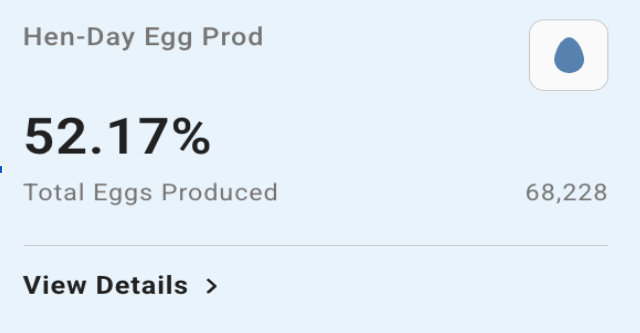
Figure 1. Aviarai Hen-Day Egg Production (HDEP) KPI showing farm-level production performance. Source: Aviarai platform.
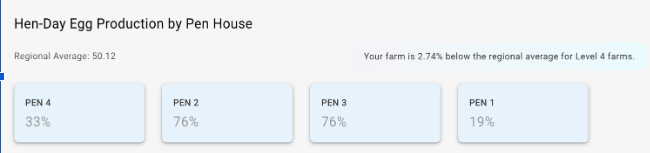
Figure 2. Aviarai HDEP benchmarking view showing pen-house performance alongside the regional benchmark for the farm’s comparison group. Source: Aviarai platform
This allows the farmer to move through several levels of information:
Farm HDEP → Pen-house HDEP → Regional benchmark → Comparative performance
The distinction is important. A conventional KPI display can tell a farmer the farm’s HDEP. Benchmarking adds context by helping the farmer evaluate how that performance compares with an external reference population.
The benchmark itself does not determine why a farm is performing differently or prescribe what action must be taken. A difference may warrant further evaluation of flock age, breed, feed intake, body weight, health, environmental conditions, management practices, or other relevant factors.
Its role is to make the KPI more informative by answering an additional question:
How does this farm’s performance compare with other farms in its regional comparison group?
Example: Benchmarking Mortality Rate
The same benchmarking approach can be applied to mortality. In the example below, real farm records in Aviarai produced a mortality rate of 0.03%, based on 41 recorded mortalities. Aviarai displays the underlying daily mortality counts and compares the farm’s mortality rate with a regional average of 0.03% for its applicable farm-level comparison group.
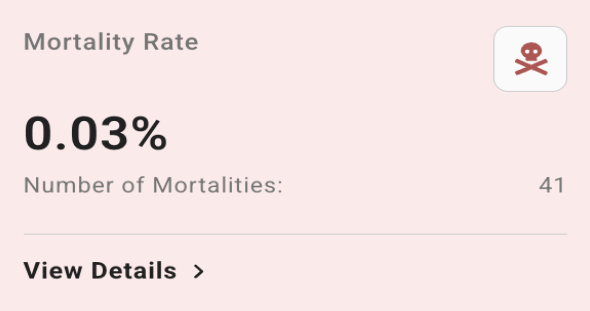
Figure 3. Aviarai Mortality Rate KPI showing the farm’s mortality rate and total number of mortalities. Source: Aviarai platform
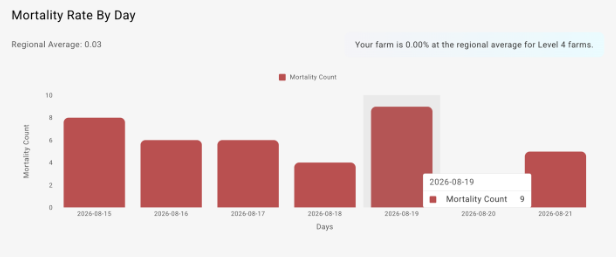
Figure 4. Aviarai mortality benchmarking view showing daily mortality alongside the regional benchmark for the farm’s comparison group. Source: Aviarai platform
In this instance, the farm is at the regional average. The farmer can therefore move from an aggregate mortality KPI to the daily records contributing to that result, while also seeing how the farm compares with an external regional benchmark:
Daily mortality records → Farm mortality rate → Regional benchmark → Comparative interpretation
This does not mean that a regional benchmark determines whether a flock is healthy or diagnoses the cause of mortality. Mortality can be influenced by disease, age, management, environment, nutrition, flock population, and many other factors. Veterinary investigation may be required when mortality patterns warrant concern.
The benchmark instead provides additional context. A mortality rate viewed in isolation tells the farmer what occurred on the farm. A mortality rate viewed alongside an appropriate reference point provides additional information about how that result compares with the performance observed elsewhere.
From KPIs to Benchmarking Intelligence
Within Aviarai, benchmarking is one implementation of Poultry Decision Intelligence: operational farm data is transformed into KPIs, placed against relevant reference data, and returned to the farmer as comparative performance intelligence.
These examples illustrate a broader distinction between measuring performance and interpreting performance in context.
A KPI such as HDEP, mortality rate, feed conversion ratio, feed intake, egg mass, or body weight is valuable on its own. It quantifies an aspect of flock performance.
Benchmarking adds another analytical layer:
What is the farm’s result? → What is the relevant benchmark? → How does the farm compare?
Benchmarking is integrated across Aviarai’s 52 commercial poultry KPIs, allowing farmers to evaluate individual farm and flock metrics against regional reference data. Where applicable, Aviarai also interprets the comparison by indicating whether the farm is above, below, or at the regional average for its comparison group.
This is one way Poultry Decision Intelligence can increase the value of routine farm records. The underlying data remains important, but the farmer is no longer limited to asking:
“What is my KPI?”
The farmer can also ask:
“How does this performance compare with an appropriate reference group, and is the difference something I should examine more closely?”
That transition from measurement toward contextual interpretation is what makes benchmarking an intelligence capability rather than simply another number on a poultry dashboard.
15. Does Poultry Decision Intelligence Require Sensors or IoT Hardware?
No. Poultry Decision Intelligence does not inherently require sensors, IoT devices, cameras, automated equipment, or proprietary farm hardware.
The defining characteristic of Poultry Decision Intelligence is not how farm data is collected, but what happens to the data after it becomes available.
This distinction separates two different functions:
Data acquisition → How is information about the farm or flock collected?
Decision Intelligence → How is that information analyzed and transformed into recommendations, forecasts, alerts, benchmarks, predictions, or other decision-support insights?
Sensors and IoT technologies can be valuable sources of data, but they are only one way of generating the information that a Decision Intelligence system can analyze.
Poultry Farms Already Generate Valuable Data
Commercial poultry farms generate operational data every day, even without sensors.
Farmers routinely record information such as:
- feed intake;
- egg production;
- mortality;
- flock population;
- body weight;
- vaccination;
- inventory;
- sales;
- expenses; and
- other production and management activities.
When these records are collected consistently, they can provide a substantial data foundation for Poultry Decision Intelligence.
For example, a farmer does not necessarily need an automated feed sensor for a Decision Intelligence system to analyze feed intake. If the farm accurately records the quantity of feed given to a flock, that operational record can become an input for analysis.
Similarly, egg production does not necessarily need to be captured by an automated egg-counting system. Consistently recorded daily production data can be analyzed alongside flock age, population, feed intake, historical performance, and other relevant variables.
Sensors Are an Input Mechanism, Not a Requirement
Where sensors, cameras, environmental monitors, automated scales, or IoT systems are available, their data can enrich the information available for analysis.
For example:
Environmental sensor → Temperature and humidity data
Automated scale → Body-weight data
Feed monitoring system → Feed-consumption data
Camera or computer-vision system → Behavioral or production data
These technologies can increase the frequency, granularity, or automation of data collection.
But the intelligence layer comes afterward:
Farm records / Sensors / IoT / External data → Data → Contextual analysis → Decision Intelligence → Farmer decision
This means a poultry farm can benefit from Decision Intelligence without first becoming a highly automated or sensor-equipped operation.
Why Hardware Independence Matters
Requiring specialized hardware can create additional barriers to adoption, particularly where farmers must purchase, install, maintain, power, and connect new equipment before receiving value from a digital platform.
A hardware-independent approach allows farms to begin with something they already have:their operational farm data.
As the farm adopts additional technologies over time, new data sources can potentially be incorporated without making those technologies a prerequisite for Decision Intelligence itself.
This is particularly relevant in poultry markets where farms vary substantially in size, infrastructure, connectivity, automation, and access to capital.
How Aviarai Approaches Hardware Independence
Aviarai is designed as a hardware-independent Poultry Decision Intelligence Platform. It does not require proprietary sensors, IoT devices, or specialized poultry-house equipment for farmers to use its core farm-management and intelligence capabilities.
Farmers can enter the operational data they already generate through routine poultry production, and Aviarai can use relevant portions of that data to support analysis, predictions, recommendations, alerts, benchmarking, and other intelligence capabilities.
Aviarai Smart Feed provides a practical example.
Smart Feed does not require a proprietary feed sensor or automated feeding system to generate its flock-specific feed recommendations. Instead, it uses relevant flock records captured in Aviarai to support the recommendation. The farmer remains responsible for evaluating and implementing the feeding decision.
Hardware independence, however, does not mean that sensor data has no value. Where useful data from sensors, IoT systems, environmental monitoring, or other technologies is available and can be integrated, it can provide additional context for Decision Intelligence.
The distinction is therefore straightforward:
Sensors can improve how poultry data is collected. Poultry Decision Intelligence determines how relevant data is analyzed and transformed into intelligence that supports decisions.
The intelligence is the essential layer. Specialized hardware is not.
16. Does Poultry Decision Intelligence Replace Farmers, Veterinarians, or Poultry Nutritionists?
No. Poultry Decision Intelligence does not replace farmers, veterinarians, or poultry nutritionists. It augments human decision-making by providing an additional intelligence layer that helps professionals and farm managers make better-informed decisions using available farm and flock data.
Artificial intelligence can analyze large amounts of information, identify patterns, generate predictions, detect deviations, and provide recommendations. But poultry production involves biological complexity, physical farm conditions, professional judgment, and real-world circumstances that cannot be reduced to data alone.
The role of Poultry Decision Intelligence is therefore to support human expertise, not replace it.
The Farmer Remains the Decision-Maker
Farmers and farm managers remain responsible for production and management decisions.
Poultry Decision Intelligence may provide a recommendation, forecast, alert, benchmark, or performance insight, but the farmer determines how that intelligence should be used.
For example, a system may indicate that flock data supports a change in feed allocation. Before implementing that recommendation, the farmer may also consider:
- direct observation of the birds;
- feed quality and availability;
- current environmental conditions;
- recent management changes;
- flock health;
- available resources; and
- professional advice where necessary.
Decision Intelligence gives the farmer another source of information to consider.
The relationship is:
Farm data → Decision Intelligence → Farmer evaluation → Farmer decision
not:
Farm data → AI → Automatic decision
Poultry Decision Intelligence Does Not Replace Veterinarians
Veterinarians provide professional expertise in poultry health, disease prevention, diagnosis, treatment, biosecurity, and flock-health management.
AI can support this work by identifying unusual patterns in farm data.
For example, a Decision Intelligence system may detect that mortality is increasing beyond expected levels while feed intake or egg production is also changing. That information can alert the farmer that the flock may require closer investigation.
But identifying an abnormal pattern is fundamentally different from diagnosing its cause.
The distinction is important:
AI:
“Something unusual may be happening.”
Veterinary investigation:
“What is causing it?”
A veterinarian may need to examine birds, review flock history, perform necropsies, request laboratory testing, evaluate management conditions, or conduct other diagnostic procedures before determining the cause and appropriate response.
A health-risk alert is not a veterinary diagnosis.
Poultry Decision Intelligence can help identify when professional attention may be needed, but it does not replace veterinary diagnosis or treatment.
Poultry Decision Intelligence Does Not Replace Poultry Nutritionists
Poultry nutritionists provide specialized expertise in areas such as:
- nutrient requirements;
- diet formulation;
- ingredient selection;
- feed quality;
- nutrient density;
- feed additives;
- raw-material variability; and
- nutritional strategies for different stages of production.
Feed Decision Intelligence addresses a related but different problem.
For example, AI may analyze flock-performance data to help determine an appropriate quantity of feed per bird per day. That does not automatically determine whether the feed contains the correct levels of energy, protein, amino acids, minerals, vitamins, or other nutrients.
A flock can receive the appropriate quantity of feed while still receiving a poorly formulated diet.
Conversely, a nutritionally excellent feed can still be used inefficiently if the quantity being provided does not appropriately reflect the flock’s requirements and performance.
The two forms of expertise can therefore complement each other:
Poultry nutrition → What should the feed contain?
Feed Decision Intelligence → What does the flock’s data indicate about the feeding decision being considered?
This distinction is particularly important for capabilities such as Aviarai Smart Feed, which provides feed-quantity decision support and does not replace professional nutritional expertise.
Human Expertise and AI Can Work Together
The strongest application of Poultry Decision Intelligence is not human versus artificial intelligence.
It is:
Human expertise + Farm data + Artificial intelligence + Context = Better-informed decision-making
Farmers contribute practical knowledge of their birds, facilities, people, and operating conditions.
Veterinarians contribute specialized expertise in poultry health and disease.
Nutritionists contribute specialized expertise in poultry nutrition and feed formulation.
Artificial intelligence contributes the ability to continuously analyze data, identify patterns, detect deviations, forecast potential outcomes, and surface information that may otherwise be difficult to identify consistently.
Each contributes something different.
Poultry Decision Intelligence therefore represents decision augmentation rather than decision replacement.
AI provides the intelligence layer. Farmers and relevant poultry professionals provide the judgment, expertise, and responsibility required to turn that intelligence into appropriate action.
17. What Are the Limitations of Poultry Decision Intelligence?
Poultry Decision Intelligence can improve the information available to poultry farmers, but it does not eliminate uncertainty. Its effectiveness depends on the quality of the underlying data, the capabilities and limitations of the analytical models, the conditions affecting the flock, and how the resulting intelligence is interpreted and implemented.
Poultry production involves living animals operating within dynamic biological, environmental, management, and economic systems. No analytical platform can observe or predict every factor that may influence a flock.
Understanding these limitations is essential to using Poultry Decision Intelligence responsibly.
Data Quality Matters
Decision Intelligence depends on the data available for analysis.
If farm records are accurate, timely, and consistently collected, they can provide a stronger foundation for analysis. If the underlying data is inaccurate, the resulting intelligence may also be less reliable.
Examples include:
- incorrect feed quantities;
- inaccurate egg counts;
- incorrect flock populations;
- inaccurate mortality records;
- inconsistent body-weight measurements;
- incorrect dates or flock ages; and
- inaccurate sales, inventory, or expense records.
Artificial intelligence cannot automatically make incorrect farm data correct simply by analyzing it.
Missing or Inconsistent Records Can Reduce Reliability
Gaps in farm records can also affect the quality of analysis.
A system attempting to identify a production trend, for example, may have less information available if several days of egg-production or feed-intake records are missing.
This is why some Decision Intelligence capabilities may require a minimum amount of recent or historical data before generating farm- or flock-specific intelligence.
Consistency matters as much as volume. More data is not necessarily better if that data is unreliable or collected inconsistently.
Models Have Limitations
AI and predictive models are representations of patterns and relationships found in data. They are not perfect representations of biological reality.
A model may perform differently when applied to:
- different breeds or strains;
- different flock ages;
- different production systems;
- different geographic environments;
- unusual production conditions; or
- circumstances that are poorly represented in the data used to develop or evaluate the model.
Models therefore require continued evaluation as additional data and operating conditions become available.
Unexpected Biological Events Can Change Outcomes
Poultry flocks are biological systems, and unexpected events can cause performance to change rapidly.
A flock that has been performing predictably may suddenly experience:
- disease;
- heat stress;
- water disruption;
- nutritional problems;
- feed contamination;
- equipment failure;
- severe stress; or
- another biological or operational event.
A prediction generated before such an event may no longer accurately represent what happens afterward.
This is one reason continuous re-evaluation is important within Poultry Decision Intelligence.
Disease Outbreaks Can Disrupt Expected Patterns
Disease can alter mortality, feed intake, egg production, body weight, and other flock-performance indicators.
Decision Intelligence may help detect that a flock’s performance is deviating from expected patterns, but it may not be able to determine the underlying disease responsible for the deviation.
A health-risk alert therefore indicates that something may warrant investigation. It is not a veterinary diagnosis.
Clinical examination, necropsy, laboratory testing, or other veterinary procedures may still be necessary.
Management Changes Can Alter the Data
Changes made by farm personnel can influence subsequent performance.
Examples include:
- changing feed;
- adjusting feed quantity;
- changing lighting programs;
- moving birds;
- changing vaccination programs;
- introducing new management practices;
- changing housing conditions; or
- modifying equipment.
If these changes are not captured in the available data, a model may observe a change in flock performance without having complete information about what contributed to it.
Context therefore remains important when interpreting AI-generated intelligence.
Feed Quantity Data Does Not Tell the Entire Nutritional Story
Feed-related intelligence also has important limitations.
Knowing how much feed a flock receives does not necessarily reveal the nutritional quality of that feed.
Variations in:
- raw-material quality;
- nutrient composition;
- energy density;
- amino acid levels;
- ingredient digestibility;
- mycotoxin contamination;
- feed manufacturing quality; and
- storage conditions
can affect flock performance even when feed quantity is accurately recorded.
This is one reason Feed Decision Intelligence should complement rather than replace sound poultry nutrition and professional nutritional expertise.
Environmental Conditions Can Change Quickly
Temperature, humidity, ventilation, season, weather, and other environmental factors can influence poultry performance.
Where relevant environmental information is available, it can provide valuable context for analysis. However, unexpected or highly localized conditions may not always be captured completely.
A sudden environmental change can therefore cause actual flock performance to differ from what was previously predicted.
Prediction Is Not Certainty
A prediction is an estimate of a future outcome based on the information available at the time it is generated. It is not a guarantee.
An egg-production forecast does not guarantee that the flock will produce the predicted number of eggs.
A mortality forecast does not guarantee a specific number of deaths.
An inventory forecast does not guarantee exactly when stock will be depleted.
A revenue forecast does not guarantee future revenue.
Predictions should therefore be interpreted as decision-support information under uncertainty, not statements of certainty about future events.
As new information becomes available, forecasts and recommendations can be reassessed.
Human Implementation Still Matters
Even a highly accurate recommendation has limited value if it is not interpreted and implemented appropriately.
The farmer may need to determine:
- whether the recommendation is practical;
- whether current farm conditions support implementation;
- when an intervention should occur;
- whether professional advice is required;
- whether circumstances have changed since the intelligence was generated; and
- whether subsequent flock performance requires a different response.
The outcome of a decision can therefore depend not only on the quality of the intelligence but also on how, when, and under what conditions it is implemented.
Decision Intelligence Reduces Information Gaps, Not Biological Uncertainty
The purpose of Poultry Decision Intelligence is not to create an illusion of certainty in poultry production.
Its purpose is to give farmers a stronger information base for making decisions.
That distinction is fundamental:
Poultry Decision Intelligence improves the information available for decision-making. It does not eliminate biological uncertainty or management responsibility.
Farmers still need to observe their flocks, maintain accurate records, apply sound management practices, evaluate changing farm conditions, and seek veterinary, nutritional, or other professional expertise when appropriate.
The value of Decision Intelligence is therefore not that it will always be right.
Its value is that it can help farmers move from making decisions with limited, fragmented, or purely retrospective information toward decisions informed by systematic analysis of the data and context available at the time.
18. How Does Aviarai Apply Poultry Decision Intelligence?
Aviarai is Africa’s first specialized Poultry Decision Intelligence Platform.
Aviarai combines poultry farm management with artificial intelligence, predictive analytics, farm-specific data, and hyperlocal intelligence to transform everyday poultry farm records into recommendations, forecasts, alerts, benchmarks, and actionable performance insights.
This combination is important because Poultry Decision Intelligence requires a reliable data foundation. Before a platform can generate flock-specific intelligence, it needs relevant information about what is actually happening on the farm.
Aviarai addresses both sides of that equation.
It provides the farm-management infrastructure for capturing and organizing operational data and an intelligence layer for transforming relevant portions of that data into information that can support decisions.
The architecture can be understood in three connected layers:
Farm Management Layer
↓
Intelligence Layer
↓
Decision-Support Layer
Farm Management Layer: Capturing the Farm’s Operational Reality
The Farm Management Layer provides the data foundation for Aviarai’s intelligence capabilities.
Farmers use Aviarai to capture and manage operational information such as:
- feed intake;
- egg production;
- mortality;
- flock population;
- body weight;
- vaccination;
- inventory;
- sales;
- expenses; and
- other farm and flock records.
These are not simply administrative records.
Collectively, they create a growing digital history of the individual farm and its flocks.
This allows Aviarai to move beyond relying exclusively on generalized assumptions about poultry production and incorporate information about what is actually happening within a particular flock.
Intelligence Layer: Analyzing Data in Context
The Intelligence Layer transforms relevant farm records into something more useful than a historical report.
Aviarai applies artificial intelligence, predictive analytics, analytical models, farm-specific data, and relevant contextual or hyperlocal information to evaluate patterns and relationships within poultry operations.
Depending on the intelligence being generated, the platform can consider factors such as flock age, breed, population, historical performance, feed intake, egg production, mortality, body weight, location, economic information, and other relevant variables.
This layer addresses the question:
What does the available data mean for this particular farm or flock?
Rather than assuming that every flock of the same breed should be treated identically, Aviarai can use the flock’s own operational history and context as part of the analytical process.
Decision-Support Layer: Turning Analysis Into Actionable Intelligence
The Decision-Support Layer converts analysis into outputs that farmers can evaluate and use.
These outputs can include:
Recommendations
What action or adjustment should the farmer consider?
Forecasts and predictions
What production, biological, operational, or economic outcome may occur next?
Alerts
Is something unusual developing that may require attention?
Benchmarks
How is the flock performing relative to an appropriate reference or contextual comparison?
Performance insights
What patterns or changes within the farm’s data should the farmer understand?
The farmer remains responsible for evaluating this intelligence and making the final decision.
The complete Aviarai process therefore becomes:
Farm operations → Farm data → Contextual analysis → Aviarai intelligence → Farmer decision → Outcome → New farm data → Re-evaluation
How Aviarai Applies Decision Intelligence Across the Poultry Farm
Poultry Decision Intelligence is not limited to one production decision. Aviarai applies the concept across multiple areas of commercial poultry management.
Smart Feed
Aviarai Smart Feed transforms layer-flock data into dynamic daily feed recommendations expressed in grams per bird per day.
Instead of relying only on standardized feeding references, Smart Feed analyzes relevant information from the individual flock to support a more precise feeding decision. As new performance data becomes available, the flock can be re-evaluated and subsequent recommendations generated.
This creates a continuous loop:
Flock data → Feed intelligence → Recommendation → Farmer decision → Performance → New flock data → Re-evaluation
This is one of the clearest examples of Poultry Decision Intelligence in practice.
Egg-Production Forecasting
Aviarai uses current and historical flock data to generate expected egg-production performance.
The resulting prediction can subsequently be compared with actual recorded production, turning everyday egg records into forward-looking production intelligence.
Aviarai has also published first-party field observations comparing its projected HDEP with subsequently recorded HDEP in a commercial layer flock, providing a practical example of the prediction-to-outcome cycle.
Mortality Forecasting
Aviarai can analyze flock mortality history and relevant performance data to estimate expected mortality.
As actual mortality is recorded, it can be compared with expected patterns, providing farmers with a forward-looking reference rather than only a historical mortality count.
Health and Risk Intelligence
Aviarai can analyze changes and deviations within flock-performance data to identify unusual patterns that may require investigation.
The purpose is early awareness, not diagnosis.
A health-risk alert from Aviarai is not a veterinary diagnosis.
It provides additional information that a farmer can use when determining whether closer observation, management intervention, or veterinary investigation is required.
Contextual KPI Benchmarking
Aviarai can help farmers move beyond looking at a KPI in isolation by comparing performance against relevant references and, as appropriate data becomes available, contextual peer groups.
This can help farmers understand not simply what their HDEP, FCR, mortality, feed intake, or other KPI is, but how that performance compares within a meaningful context.
Inventory Intelligence
Aviarai combines inventory records with farm usage and consumption data to help farmers understand stock movements, anticipate requirements, and identify potential inventory shortages.
This moves inventory management from:
“What do I have?”
toward:
“Based on how the farm is operating, what might I need next?”
Vaccination Management and Intelligence
Aviarai uses flock information and vaccination programs to help farmers organize and manage vaccination schedules, upcoming activities, and vaccination histories.
This connects routine flock-management data with forward-looking operational planning.
Financial and Profitability Intelligence
Aviarai connects production data with economic information such as sales, expenses, feed costs, egg prices, and revenue.
This allows the intelligence layer to extend beyond biological performance into the economics of poultry production through capabilities such as revenue forecasting, break-even forecasting, egg-price forecasting, and profitability analysis.
The objective is to help farmers understand not only:
“Is my flock producing?”
but also:
“What does this production performance mean economically for my farm?”
Farm Management and Decision Intelligence in One Platform
This is ultimately what distinguishes Aviarai’s architecture.
Aviarai is not simply a system where farmers enter records and receive dashboards. Nor is it an AI layer disconnected from the realities of daily farm operations.
It connects the two:
Poultry Farm Management
captures the farm’s operational reality.
↓
Poultry Decision Intelligence
analyzes that reality and helps determine what it may mean.
↓
Farmer Decision-Making
turns the resulting intelligence into action.
The same data infrastructure that helps a farmer manage daily poultry operations can therefore become the foundation for feed recommendations, production forecasts, mortality forecasts, health alerts, contextual benchmarking, inventory intelligence, vaccination management, and financial and profitability intelligence.
That is how Aviarai applies Poultry Decision Intelligence:
It transforms the data poultry farms already generate from a record of what happened into an intelligence layer for understanding what is happening, anticipating what may happen next, and helping farmers decide what to do about it.
19. Poultry Decision Intelligence at a Glance
Poultry Decision Intelligence can be summarized as the intelligence layer that transforms poultry farm data into information that supports better-informed production and economic decisions.
Poultry Decision Intelligence at a Glance
| Attribute | Poultry Decision Intelligence |
|---|---|
| Definition | Use of poultry farm data, artificial intelligence, predictive analytics, and farm-specific context to support better-informed production and economic decisions |
| Primary Purpose | Transform poultry farm data into actionable intelligence that supports decision-making |
| Data Foundation | Operational poultry farm and flock records combined with relevant contextual data |
| Key Outputs | Recommendations, forecasts, predictions, alerts, benchmarks, and performance insights |
| Decision Domains | Feed, production, flock performance, health and risk, benchmarking, inventory, vaccination, financial performance, and profitability |
| AI Role | Pattern recognition, prediction, anomaly detection, relationship analysis, forecasting, and recommendation support |
| Context | Can incorporate flock, farm, location, environmental, economic, historical, and other relevant contextual variables |
| Hardware Required? | No. Poultry Decision Intelligence does not inherently require sensors, IoT devices, or proprietary hardware |
| Replaces the Farmer? | No. It supports the farmer, who remains responsible for production and management decisions |
| Replaces a Veterinarian? | No. Health-risk intelligence and alerts are not veterinary diagnoses |
| Replaces a Poultry Nutritionist? | No. Feed Decision Intelligence complements professional expertise in nutrition, feed formulation, nutrient requirements, and feed quality |
| Continuous Process? | Yes. New farm and flock data can be incorporated into subsequent analysis, forecasts, recommendations, and alerts |
| Example Platform | Aviarai |
| Aviarai's Role | Africa's first specialized Poultry Decision Intelligence Platform |
The distinction is not global guidance versus Aviarai. It is global guidance plus flock-specific intelligence.
Example: Breed Reference vs. Flock-Specific Recommendation
Consider an ISA Brown flock. According to the ISA Brown Commercial Management Guide, the feed-intake benchmark from 28 weeks of age is 115 grams per bird per day. That benchmark is valuable because it provides a standardized reference for the breed.
Aviarai Smart Feed adds another layer. Once an eligible flock has sufficient farm data, Smart Feed analyzes the flock’s own records and can generate a daily recommendation that differs from the global reference when the flock-specific data supports it.
For example, a Smart Feed recommendation of 112 grams per bird per day does not mean that the ISA Brown 115-gram reference is incorrect. It means that Aviarai is providing an additional flock-specific recommendation for the farmer to consider alongside the standardized reference.
Frequently Asked Questions About Poultry Decision Intelligence
What is Poultry Decision Intelligence?
Poultry Decision Intelligence is the use of poultry farm data, artificial intelligence, predictive analytics, and farm-specific context to help poultry farmers understand flock performance, anticipate future outcomes, and make better-informed production and economic decisions. It transforms operational farm data into recommendations, forecasts, alerts, benchmarks, predictions, and performance insights.
How does Poultry Decision Intelligence work?
Poultry Decision Intelligence follows a continuous intelligence loop:
Data → Context → Analysis → Intelligence → Farmer Decision → Outcome → New Data
Farm and flock data is analyzed within relevant context to generate decision-support intelligence. The farmer evaluates that intelligence, makes a decision, and the resulting farm activity generates new data that can inform subsequent analysis.
What data does Poultry Decision Intelligence use?
Poultry Decision Intelligence can use flock, production, health, management, operational, economic, environmental, and contextual data. This may include flock age, breed, population, feed intake, egg production, mortality, body weight, vaccination, inventory, sales, expenses, location, weather, and historical performance. The specific inputs depend on the intelligence being generated.
How is Poultry Decision Intelligence different from poultry farm management software?
Poultry farm management software primarily helps farmers digitize, organize, monitor, and report farm operations. Poultry Decision Intelligence goes further by analyzing farm data to generate recommendations, predictions, forecasts, alerts, contextual benchmarks, and decision-support insights. A single platform can provide both capabilities.
Is Poultry Decision Intelligence the same as Precision Livestock Farming?
No. Precision Livestock Farming commonly focuses on technologies such as sensors, cameras, IoT devices, monitoring systems, and automation for collecting data about animals and their environment. Poultry Decision Intelligence focuses on transforming available data into intelligence that supports decisions. The two approaches can complement each other.
How does AI help poultry farmers make decisions?
AI can analyze historical and current poultry data to identify patterns, evaluate relationships among variables, detect deviations, forecast outcomes, and generate farm- or flock-specific recommendations. This can help farmers move beyond simply reviewing historical records toward anticipating what may happen next and determining what may require attention.
Can AI optimize poultry feed?
Yes. AI can analyze flock-specific data such as feed intake, egg production, flock age, population, and historical performance to support more precise feeding decisions. The objective is feed optimization, not simply feed reduction. Depending on the flock’s data, an appropriate recommendation could be lower, higher, or unchanged.
Can AI predict egg production?
Yes. AI can use historical and current flock data to estimate future egg production. These predictions can support production planning, sales planning, financial forecasting, and performance monitoring. An egg-production forecast is an estimate based on available data, not a guarantee of future production.
Can AI predict poultry mortality?
Yes. AI can analyze historical mortality and other relevant flock-performance data to estimate expected future mortality. Actual mortality can then be compared with predicted or expected patterns as new flock data becomes available.
Can AI detect poultry health risks?
AI can help identify unusual mortality, feed-intake, production, body-weight, or other performance patterns that may indicate a potential health risk requiring investigation. A health-risk alert is not a veterinary diagnosis. Determining the cause of a health problem may require professional veterinary examination, diagnostic testing, or other investigation.
What is contextual poultry benchmarking?
Contextual poultry benchmarking compares flock performance against relevant peer or reference groups while considering factors that make the comparison meaningful, rather than comparing every poultry farm against one universal benchmark. Relevant context can include breed, flock age, production stage, location, farm characteristics, and other variables.
Does Poultry Decision Intelligence require sensors or IoT hardware?
No. Poultry Decision Intelligence does not inherently require sensors, IoT devices, cameras, or proprietary farm hardware. Sensors can provide valuable data, but routine operational farm records can also provide the data foundation for Decision Intelligence.
Does Poultry Decision Intelligence replace poultry farmers?
No. Poultry Decision Intelligence supports rather than replaces the farmer. It provides recommendations, forecasts, alerts, benchmarks, and other intelligence, while the farmer remains responsible for evaluating the information and making production and management decisions.
Does Poultry Decision Intelligence replace veterinarians or poultry nutritionists?
No. Veterinarians retain responsibility for professional diagnosis and veterinary treatment, while poultry nutritionists provide expertise in nutrition, feed formulation, nutrient requirements, and feed quality. Poultry Decision Intelligence provides an additional analytical and decision-support layer that can complement this professional expertise.
What is an example of a Poultry Decision Intelligence Platform?
Aviarai is Africa’s first specialized Poultry Decision Intelligence Platform. Aviarai combines poultry farm management, artificial intelligence, predictive analytics, farm-specific data, and hyperlocal intelligence to transform everyday poultry farm records into recommendations, forecasts, alerts, benchmarks, predictions, and actionable performance insights.