
What Is Poultry Egg Production Intelligence?
1. What Is Poultry Egg Production Intelligence?
Poultry Egg Production Intelligence is the use of flock-specific production data, historical performance, standardized production references, and relevant farm context to understand egg-production performance, identify meaningful deviations, detect potentially abnormal production behavior, and forecast how a commercial layer flock is likely to perform over time.
Poultry Egg Production Intelligence, sometimes shortened here to Egg Production Intelligence, transforms commercial layer production records into intelligence that can help farmers understand what is happening with a particular flock and anticipate what may happen next.
Traditional poultry production records tell farmers how many eggs a flock produced. Instead of simply recording how many eggs a flock produced, Egg Production Intelligence goes further.
Egg Production Intelligence adds an analytical layer that helps interpret what those production records mean.
It asks:
What does the flock’s production performance mean?
How does actual production compare with what would reasonably be expected?
Is the flock’s production trajectory changing?
And, where predictive capabilities are available, what production performance should reasonably be expected next?
It can help answer questions such as:
- How is this flock actually performing?
- Is production following the expected trajectory?
- Is production changing faster or slower than expected?
- How does actual production compare with an appropriate reference?
- What is the flock likely to produce next?
- Does a change in production warrant closer investigation?
For commercial layer farms, the objective is not simply to record egg production or collect more production data.
The objective is to transform poultry egg-production data into intelligence that helps farmers understand what is happening with a particular flock and anticipate what may happen next. This level of intelligence enables farmers to make better poultry production decisions.
For commercial layer farms, Egg Production Intelligence can include analysis of daily egg production, Hen-Day Egg Production (HDEP), historical production patterns, expected production, production deviations, and flock-specific production forecasts.
Poultry Egg Production Intelligence is therefore a specialized application of the broader concept of Poultry Decision Intelligence, where poultry farm data are transformed into forecasts, recommendations, alerts, benchmarks, predictions, and other intelligence that can support farmer decisions.
2. Why Does Poultry Farming Need Poultry Egg Production Intelligence?
Egg production is one of the most important measures of performance on a commercial layer farm.
Farmers routinely record the number of eggs produced and monitor production indicators such as:
- egg weight;
- peak production;
- daily egg production;
- production percentage;
- hen-housed egg production;
- production persistency; and
- cumulative egg production.
These records are essential. But a production number alone does not necessarily tell the farmer whether the flock is performing appropriately.
Consider a flock producing at 78% HDEP. That is a production measurement. It does not, by itself, answer:
- Is 78% good?
- Is 78% poor?
- Is 78% appropriate for this flock at this point in its production cycle?
- Is it expected for the flock’s age?
- Is the change normal variation or potentially meaningful?
- Is production declining normally as the flock ages, or faster than expected?
- How does the flock compare with its own recent trajectory?
- What should production reasonably look like tomorrow or next week?
The number 78% cannot answer those questions by itself.
It requires context. Egg Production Intelligence adds that context and analytical layer. That distinction separates production recording from production intelligence.
3. What Problem Does Poultry Egg Production Intelligence Solve?
The fundamental problem is the gap between recording egg production and understanding egg-production performance.
Commercial layer farms can generate large quantities of production data:
- Daily eggs collected.
- Flock population.
- Mortality.
- Feed intake.
- Body weight.
- Hen-Day Egg Production.
- Hen-Housed Egg Production.
- Egg weight.
- Environmental information.
- Flock age.
- Historical production.
Yet having these records does not automatically mean the farm understands what they indicate about the flock. The challenge is not simply obtaining another production number.
A farm may know exactly what happened yesterday while still being uncertain about what is happening to the flock’s production trajectory or what is likely to happen next.
The challenge is not simply obtaining another production number. The challenge is interpreting those numbers in context. Egg Production Intelligence attempts to close that gap.
It asks: How is this flock actually producing, and how is its production likely to change?
Two laying flocks can have the same HDEP today while having very different production situations.
One flock may have declined from 84% to 78%.
Another may have increased from 72% to 78%.
A third may have remained around 78% for several days.
The current HDEP is identical. The production trajectory is not.
Similarly, two flocks of the same breed and age do not necessarily perform identically.
Actual production can be influenced by differences in:
- flock age;
- flock population;
- historical egg production;
- feed intake;
- body weight;
- mortality;
- health;
- environmental conditions;
- weather;
- housing;
- lighting;
- nutrition;
- management practices; and
- previous flock performance.
Breed performance objectives remain valuable, standardized references. For example, ISA publishes production characteristics and performance information for ISA Brown commercial layers.
But a standardized performance reference cannot automatically observe how an individual flock’s production is changing from day to day.
Egg Production Intelligence adds that flock-specific analytical layer.
4. How Does Egg Production Intelligence Work?
Egg Production Intelligence can be understood as a recurring data-to-decision cycle:
Flock data → Production context → Production analysis → Prediction and/or anomaly detection → Production intelligence → Farmer interpretation → Farmer decision → Flock outcome → New data
Figure 1. Poultry Egg Production Intelligence Data-to-Decision Cycle
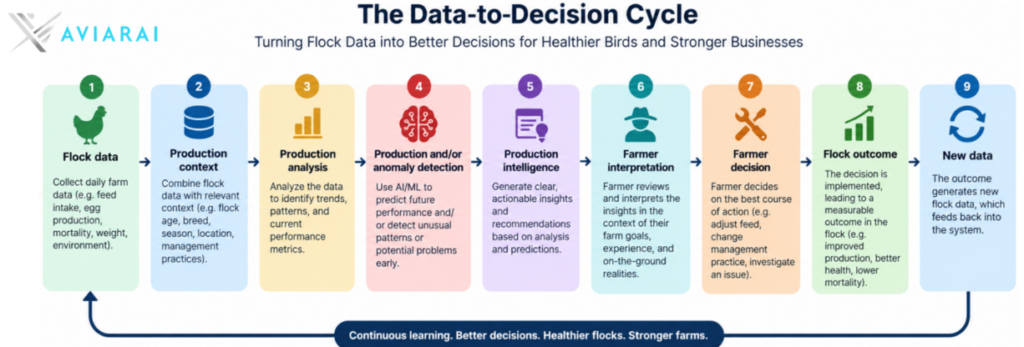
The process begins with production information generated through normal farm operations. Relevant data are evaluated within the context of the particular flock and its historical performance.
The resulting analysis may consider current and recent production, production trends, rate of change, historical patterns, deviations from expected performance, relationships with other flock variables, and relevant environmental or operational context.
- Where predictive models are available, the system can estimate how production may develop.
- Where anomaly-detection capabilities are available, the system may identify production behavior that differs meaningfully from the flock’s expected pattern.
The resulting intelligence can then support farm-management decisions. As new production outcomes are recorded, those observations become additional information for subsequent analysis.
This creates a feedback loop in which the flock’s accumulating production history becomes part of the information used to understand future performance.
5. What Data Can Egg Production Intelligence Analyze?
The exact information used depends on the system, analytical objective, and available farm data.
Relevant information may include:
- flock age;
- flock population;
- breed;
- daily egg production;
- Hen-Day Egg Production;
- Hen-Housed Egg Production;
- historical egg production;
- egg weight;
- body weight;
- feed intake;
- mortality;
- historical flock performance;
- production stage;
- environmental conditions;
- weather; and
- other relevant production variables.
Not every Egg Production Intelligence system needs to use every variable.
The important distinction is that production performance is interpreted using relevant flock-specific information rather than being viewed only as an isolated daily number.
Research supports the feasibility of using combinations of production, age, feed, environmental, and historical data to model or forecast poultry production. Machine-learning studies have used variables such as age, feed intake, water consumption, temperature, humidity, and other environmental factors to predict production-related outcomes.
Egg Production Data vs. Poultry Egg Production Intelligence
The distinction is important.
Egg-production data records what happened.
Egg Production Intelligence attempts to interpret what those records mean and what may happen next.
For example:
11,000 eggs collected is production data.
78.6% HDEP is a calculated production KPI.
81% expected HDEP may represent a standardized production reference.
But:
This flock is producing below its expected trajectory, and its recent production pattern suggests that the deviation requires closer investigation.
This context is production intelligence.
Similarly:
Based on this flock’s recent production history and relevant context, its expected production for the next period is X.
This is predictive production intelligence.
A farm can therefore have excellent digital egg-production records without having Egg Production Intelligence.
Recording production tells the farmer what happened. Egg Production Intelligence helps the farmer understand what those records mean.
6. What Is Hen-Day Egg Production?
Hen-Day Egg Production, commonly abbreviated as HDEP, expresses egg production relative to the number of live hens in the flock during a given period.
A simplified daily calculation is:
HDEP (%) = Eggs produced ÷ Number of live hens × 100
For example, if 10,000 live hens produce 8,000 eggs in one day:
HDEP = 80%
HDEP is one of the most widely useful indicators for understanding commercial layer production because it adjusts egg numbers relative to the live flock population.
However, HDEP remains a measurement.
Calculating HDEP is not, by itself, Egg Production Intelligence.
Egg Production Intelligence begins when HDEP, together with the flock’s history and relevant context are analyzed and interpreted.
Egg Production Recording vs. Poultry Egg Production Intelligence
Table 1. Egg Production Recording vs. Poultry Egg Production Intelligence
| Egg Production Recording | Poultry Egg Production Intelligence |
|---|---|
| Records how many eggs were produced | Interprets what production performance means |
| Calculates HDEP | Analyzes HDEP in context |
| Shows historical production | Evaluates production trajectory |
| Reports what happened | Helps explain whether a change may be meaningful |
| Can display a production curve | Analyzes patterns within the production curve |
| May compare performance with a reference | Can evaluate the individual flock against its own evolving performance |
| Primarily retrospective | Can include forward-looking predictions |
These concepts should not be confused. A farm can therefore maintain excellent digital production records without having Egg Production Intelligence.
Recording creates the data foundation. Intelligence interprets that data.
Poultry Egg Production Intelligence vs. Breed Production Standards
Breed performance standards and Egg Production Intelligence should not be viewed as competing approaches.
Breed standards provide valuable scientifically developed performance references.
For example, commercial layer breeding companies publish expected performance characteristics and production objectives for their genetic lines. ISA’s published information for ISA Brown layers includes indicators such as peak production, eggs per hen housed, egg weight, feed intake, body weight, and other production characteristics.
A breed reference can help answer:
- How would a flock of this breed and age generally be expected to perform under specified conditions?
Egg Production Intelligence adds another question:
- How is this particular flock actually performing, and what is it likely to do next?
Table 2. Breed Production Reference vs. Poultry Egg Production Intelligence
| Breed Production Reference | Poultry Egg Production Intelligence |
|---|---|
| Provides standardized expected performance | Provides flock-specific production analysis |
| Often organized by breed and age | Uses actual flock records and relevant context |
| Provides an expected production trajectory | Evaluates the recorded trajectory of a particular flock |
| Represents expected performance under defined conditions | Responds to the flock's actual recorded performance |
| Changes according to the published production curve | Can be re-evaluated as new flock data become available |
| Answers “How should a flock like this typically perform?” | Helps answer “How is this flock actually performing and what is likely next?” |
The limitation of a standardized reference is not that it is wrong. The limitation is that the reference cannot continuously observe and adapt itself to the accumulating performance of an individual flock on a particular farm.
ISA Brown, for example, publishes standardized commercial performance characteristics including production-related measures such as age at 50% production, peak production and eggs per hen housed.
Egg Production Intelligence does not make them obsolete. Egg Production Intelligence adds the flock-specific analytical layer. That distinction matters.
Breed expectation + Actual flock performance + Historical trajectory + Context → Flock-specific production intelligence
Actual vs. Expected Egg Production
One of the most useful applications of Egg Production Intelligence is understanding the difference between actual production and expected production.
Suppose a breed reference indicates that a flock of a particular age would typically be expected to produce at 82% HDEP.
The farm records 77% HDEP.
The five-percentage-point difference is useful information.
But the difference alone still does not explain why it exists.
The flock may be affected by factors such as:
- age;
- nutrition;
- disease;
- heat stress;
- lighting;
- body weight;
- water availability;
- management;
- housing conditions;
- environmental stress;
- feed intake; or
- previous production performance.
Egg Production Intelligence can help identify and quantify deviations.
It should not automatically assign causation to them.
That distinction is critical.
7. What Is Egg Production Deviation Intelligence?
A production deviation occurs when recorded production differs meaningfully from an appropriate expected value, historical pattern, or predicted trajectory.
For example:
Expected HDEP: 82%
Actual HDEP: 78%
Deviation: -4 percentage points
But not every deviation is equally important.
A single unusual production day may result from recording errors, egg-collection timing, operational disruption, or normal variation.
A persistent or accelerating deviation may warrant greater attention.
Egg Production Intelligence can therefore evaluate production over time rather than interpreting every daily movement in isolation.
The more useful question becomes:
Is this fluctuation normal variation, or is the flock moving away from its expected production trajectory?
8. What Is an Egg Production Curve?
A commercial layer flock’s production does not remain constant throughout its life.
Production generally changes as the flock progresses through different stages of the laying cycle.
A production curve can therefore show how production develops over time.
The curve may help visualize:
- onset of lay;
- increasing production;
- peak production;
- persistency;
- gradual decline;
- unexpected drops;
- recoveries; and
- other changes in production behavior.
Production curves have long been useful poultry-management tools.
But displaying a curve and interpreting a curve are not the same thing.
Egg Production Intelligence applies analytical methods to production history so that the curve becomes a source of decision-support information rather than only a historical visualization.
9. Why Does Production Trajectory Matter?
Consider these two sequences:
Flock A
- 82% → 81% → 80% → 79% → 78%
Flock B
- 74% → 75% → 76% → 77% → 78%
Both finish at 78% HDEP.
But their trajectories tell very different stories.
- Flock A is declining.
- Flock B is improving.
Looking only at today’s HDEP would hide that distinction.
This is why longitudinal flock data are important.
Production intelligence should consider not only where the flock is today, but how it arrived there.
10. Can AI Predict Egg Production?
Yes.
Artificial intelligence, machine learning, statistical modeling, and other forecasting techniques can be used to predict poultry egg production.
This is not merely theoretical.
Published research has explored mathematical, statistical, neural-network, support-vector-machine, random-forest, XGBoost, LSTM, CNN, and other approaches for forecasting or detecting changes in egg production.
Ji et al. used machine-learning models to predict egg production rate and egg weight in commercial broiler breeders using variables including age, feed intake, water consumption and environmental conditions. Their best-performing approach achieved egg-production-rate MAE below 2.86% across the evaluated datasets. https://www.sciencedirect.com/science/article/pii/S0032579124010368?via%3Dihub
Recent research has also evaluated egg-production forecasting using data across multiple commercial farms, illustrating both the potential and the challenges of developing models that generalize beyond a single farm.
Research in commercial free-range laying systems has also demonstrated the use of Random Forest models to forecast near-future laying rates and identify problematic production fluctuations. A 2025 study using seven commercial flocks reported regression RMSE around 2.5% and strong performance in identifying low-production days, although false positives remained an important limitation. https://www.sciencedirect.com/science/article/pii/S2772375525006112?via%3Dihub
More recent multi-farm research analyzed 106 commercial flocks representing 35,346 flock-days and found that predictive models could forecast laying rates across farm datasets, while also showing that simply adding data from additional farms did not consistently improve every performance measure. https://www.sciencedirect.com/science/article/pii/S0032579126008989?via%3Dihub
These findings are important for three reasons.
First, they demonstrate that poultry production records can support forward-looking analysis.
Second, they demonstrate why prediction quality must be measured rather than assumed.
Third, an AI-powered system may analyze relationships among variables such as production history, flock age, feed intake, population, body weight, environmental conditions, and historical performance to generate a production forecast for a particular flock. The exact variables and modeling approach depend on the system.
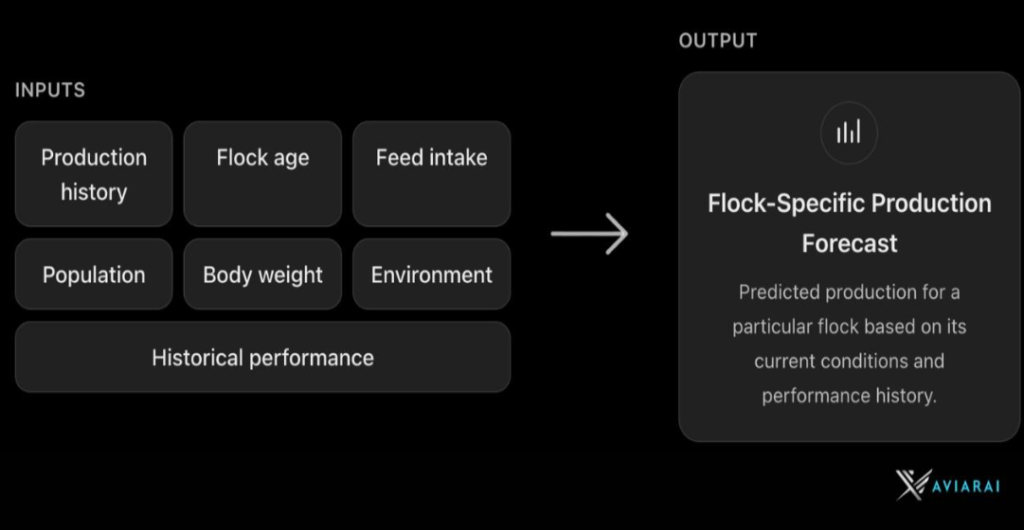
Figure 2. Flock-Level Inputs to a Flock-Specific Production Forecast
From Production Monitoring to Predictive Production Intelligence
Traditional production monitoring asks:
- What happened?
Production analysis can ask:
- What is happening?
Predictive Production Intelligence adds another question:
- What is likely to happen next?
The process can be represented as:
Historical flock data + Current flock state + Context → Predicted production trajectory → Production intelligence → Farmer decision
For commercial layer farms, predicted outcomes may include measures such as:
- expected HDEP;
- expected laying rate;
- probability of abnormal production behavior;
- expected production trend; or
- other production-performance measures.
Prediction does not mean certainty.
A prediction is an estimate of an uncertain future outcome based on available information.
Its usefulness should therefore be evaluated against what subsequently happens.
11. What Is Flock-Specific Egg Production Forecasting?
A standardized production curve describes how a representative flock is expected to perform.
A flock-specific forecast attempts to estimate how the actual flock being observed is likely to perform based on information available about that flock.
This distinction matters.
Two flocks may be:
- the same breed;
- the same age; and
- in the same production stage;
while having different:
- production histories;
- feed intake;
- body weights;
- mortality histories;
- environmental conditions;
- management conditions; and
- current production trajectories.
Their future production may therefore not be identical.
Flock-specific forecasting attempts to incorporate information about the individual flock rather than assuming that every flock will follow exactly the same standardized trajectory.
12. What Is the Difference Between a Forecast and a Breed Projection?
These terms can easily be confused.
A breed projection or performance reference describes standardized expected performance associated with a breed, age, production stage, housing system, or other specified conditions.
A flock-specific forecast attempts to estimate future performance using information about the actual flock.
Conceptually:
Breed projection:
What would a flock like this generally be expected to produce?Flock-specific forecast:
Given what has actually been happening with this flock, what should reasonably be expected next?
Both can be useful. They answer different questions.
13. Can Egg Production Intelligence Predict Peak Egg Production?
Potentially.
Peak production is an important phase in the commercial layer production cycle.
Depending on the available data and predictive system, production intelligence may help estimate:
- when a flock is approaching peak production;
- the likely magnitude of peak production;
- whether the flock’s trajectory is consistent with expected peak performance; and
- how actual peak performance compares with relevant expectations.
However, predicted peak production should be treated as a forecast, not a guarantee.
Actual flock performance remains influenced by genetics, nutrition, environment, health, management, and other factors.
14. Can Egg Production Intelligence Predict Production Decline?
Potentially.
Egg production changes as a layer flock progresses through its production cycle.
Some decline is expected.
The important analytical question is whether the observed decline is consistent with the expected trajectory or whether production is deteriorating unusually.
Production intelligence can examine:
- rate of decline;
- recent production history;
- expected production;
- previous deviations;
- flock age; and
- relevant contextual variables.
This can help distinguish an expected production transition from a pattern that may warrant investigation.
15. Can Egg Production Intelligence Detect Production Problems?
A production problem is not limited to a decline in egg production.
A commercial layer flock may experience a production problem when its recorded performance behaves differently from what would reasonably be expected given its age, production stage, historical performance, or established production pattern.
Examples may include:
- failing to reach expected production levels;
- reaching a lower-than-expected peak;
- plateauing earlier than expected;
- persistently producing below an expected trajectory;
- exhibiting unusual fluctuations in production;
- recovering differently than expected after a production disruption; or
- developing an abnormal production pattern over time.
Some of these problems may be visible to an experienced farmer. Others may become easier to recognize when production records are analyzed across time rather than viewed as isolated daily values.
Egg Production Intelligence can potentially help by establishing an expected or learned production pattern for the flock and evaluating whether subsequent performance remains consistent with that pattern.
Research has explored this concept using commercial laying-hen production data. A 2016 study applied support vector machines to production curves to identify production problems and generate early warnings. More recent research has developed adaptive, flock-specific anomaly-detection approaches that model changing production patterns over time and use deviations from those patterns to identify potentially abnormal production behavior.
The important question is therefore not simply:
Is egg production declining?
It is:
Is this flock producing in a way that is consistent with its expected production behavior, or is there an abnormal pattern that warrants investigation?
This distinction matters because normal production is not static. Egg production changes with flock age and production stage, and normal day-to-day variability can occur.
A useful Egg Production Intelligence system should therefore avoid treating every fluctuation or deviation as a production problem.
It should help distinguish between expected production behavior and potentially abnormal production behavior.
However, detecting a potential production problem is not the same as determining its cause.
An abnormal production pattern could be associated with nutrition, feed or water intake, disease, environmental conditions, lighting, management, stress, flock age, recording errors, or other factors.
Egg Production Intelligence can help identify that production behavior may be abnormal and warrant investigation. It should not automatically diagnose why the problem is occurring.
16. How Can Egg Production Intelligence Support Farm Decisions?
Production forecasts and production-performance intelligence can support many operational decisions.
For example, they may help farmers anticipate:
- expected egg availability;
- likely production changes;
- sales volumes;
- customer-supply capacity;
- packaging requirements;
- production shortfalls;
- potential revenue changes; and
- areas requiring management attention.
The distinction is important:
Egg Production Intelligence does not make all of these decisions.
It provides production intelligence that can inform them.
17. Does a Drop in Egg Production Mean the System Knows the Cause?
No.
This distinction is critical.
Detecting a production anomaly does not automatically identify its cause.
Egg production may be affected by multiple factors, including:
- feed;
- water;
- disease;
- heat stress;
- lighting;
- body weight;
- nutrition;
- environmental conditions;
- management;
- flock age; and
- other biological or operational factors.
A system may detect that production behavior differs from expectation without being able to determine why.
Therefore:
Detection is not diagnosis.
And:
Prediction is not causation.
Egg Production Intelligence should support investigation and decision-making, not convert statistical relationships into unsupported biological conclusions.
Poultry Egg Production Intelligence vs. Poultry KPI Benchmarking
Egg Production Intelligence and Poultry KPI Benchmarking overlap, but they answer different questions.
Egg Production Intelligence asks:
- How is this flock producing, and how is its production likely to change?
Poultry KPI Benchmarking asks:
- How does this flock’s performance compare with relevant performance standards, peer groups, historical cohorts, or other benchmarks?
Egg Production Intelligence may use a standardized production reference to interpret production.
But Poultry KPI Benchmarking is broader.
It may involve comparison of:
- mortality;
- feed conversion;
- egg production;
- body weight;
- feed intake;
- egg mass;
- financial performance; and
- other poultry KPIs.
Therefore:
Egg Production Intelligence → understanding and forecasting production
Poultry KPI Benchmarking → systematically comparing performance
They are complementary but distinct capabilities.
Poultry Egg Production Intelligence vs. Poultry Feed Intelligence
These are separate decision domains within Poultry Decision Intelligence.
Poultry Feed Intelligence asks:
How much feed should this flock receive?
Egg Production Intelligence asks:
How is this flock producing, and how is its production likely to change?
The two can interact.
Egg-production performance may provide useful information for a Feed Intelligence system.
Similarly, feeding decisions can affect flock performance.
But the outputs remain different.
Table 3. Poultry Feed Intelligence vs. Poultry Egg Production Intelligence
| Poultry Feed Intelligence | Poultry Egg Production Intelligence |
|---|---|
| Focuses on feed quantity | Focuses on egg-production performance |
| Interprets relevant flock data for feeding decisions | Interprets relevant flock data for production understanding and forecasting |
| Typical output: g/bird/day recommendation | Typical output: production insight, deviation or forecast |
| Core question: How much should this flock receive? | Core question: How is this flock producing and what is likely next? |
Neither category should absorb the other.
Production intelligence can also become one input into feed intelligence. Expected production, feed history, flock state, and other relevant context may together inform feed-quantity decisions.
This relationship is particularly important for commercial layers because feed and production performance are economically and biologically connected. But predicting egg production is not itself a feed recommendation. The two intelligence domains remain distinct.
Poultry Egg Production Intelligence vs. Poultry Health Alerts
A change in egg production can sometimes be a useful signal that a flock requires closer investigation.
But a production deviation is not automatically evidence of disease.
Production can change because of many factors, including:
- flock age;
- nutrition;
- environmental stress;
- management;
- lighting;
- water availability;
- housing conditions;
- recording issues; and
- health problems.
Egg Production Intelligence may identify an unusual production pattern.
A Poultry Health Alert system addresses the separate problem of detecting patterns that may indicate health-related risk and require investigation.
Therefore:
Production deviation → signal
does not automatically mean:
Disease → diagnosis
This distinction protects against overinterpretation.
18. Does Egg Production Intelligence Require Sensors or IoT?
No.
Commercial layer farms already generate useful information through routine production records.
These may include:
- eggs collected;
- flock population;
- mortality;
- feed intake;
- body weight; and
- production KPIs.
These records can provide a foundation for Egg Production Intelligence.
Sensors, cameras, environmental monitors, automated egg counters, connected scales, and other Precision Livestock Farming technologies can potentially provide additional data where available.
Research in precision livestock farming has explored automated egg counting, environmental sensing, optical monitoring, acoustic monitoring, body-weight monitoring, and other technologies for poultry production.
But Egg Production Intelligence is an analytical capability, not a particular hardware configuration. Therefore, the intelligence layer should not be confused with the data-collection mechanism.
Egg Production Intelligence is not inherently hardware-dependent. Research has demonstrated predictive poultry models using both conventional production records and richer environmental datasets.
19. How Is Poultry Egg Production Intelligence Related to Poultry Decision Intelligence?
Poultry Egg Production Intelligence is a specialized decision domain within Poultry Decision Intelligence. Egg production does not exist in isolation.
Production performance can influence or inform decisions involving:
Feeding.
Expected and actual production can provide relevant context for feed-quantity decisions.
Health.
Unexpected production changes may be one signal that warrants further investigation.
Inventory.
Production forecasts can help estimate future egg volumes.
Sales.
Expected production can support planning around available eggs.
Cash flow and profitability.
Production expectations influence expected revenue and economic performance.
Benchmarking.
Actual flock performance can be evaluated against relevant reference populations or historical performance.
This demonstrates why Egg Production Intelligence belongs within a broader Poultry Decision Intelligence system.
The same production signal can become relevant to several different farm decisions
The relationship can be represented as:
Poultry Decision Intelligence
↓
Poultry Egg Production Intelligence
↓
Production monitoring + trajectory analysis + prediction + anomaly detection
↓
Production intelligence
↓
Farmer decision
Figure 3. Poultry Egg Production Intelligence within Poultry Decision Intelligence
Poultry Decision Intelligence addresses the broader question:
What do poultry farm data mean, what may happen next, and what decision may need consideration?
Egg Production Intelligence applies that approach specifically to egg-production performance
20. Does Egg Production Intelligence Replace Farmer Judgment?
No.
A production forecast is a decision-support tool.
It does not know every circumstance occurring on a farm unless those circumstances are represented in the available data.
Farmers, poultry professionals, nutritionists, veterinarians, and farm managers may have information or observations that a model does not.
Production Intelligence should therefore support human judgment rather than automatically replace it.
A forecast can be wrong.
An unusual production pattern can have multiple explanations.
A model developed under one set of production conditions may also perform differently when applied to other farms, environments, breeds, ages, or management systems. Recent multi-farm forecasting research illustrates that model performance can vary depending on how farm datasets are combined and transferred between farms.
21. How Does Aviarai Apply Poultry Egg Production Intelligence?
Aviarai applies Poultry Egg Production Intelligence by analyzing commercial layer egg-production records and flock-performance data to help farmers understand production trends, compare expected and actual performance, and anticipate future production.
Aviarai is an AI-powered Poultry Decision Intelligence Platform. Its broader purpose is to transform poultry farm records into intelligence that can support better-informed farm decisions.
Within that architecture:
Poultry Decision Intelligence
↓
Poultry Egg Production Intelligence
↓
Production analysis and prediction
↓
Flock-specific production insight
Figure 4. Aviarai Poultry Egg Production Intelligence Architecture
Aviarai’s existing platform definition already describes Egg Production Intelligence as analyzing egg-production records and flock-performance data to monitor production trends, understand flock performance, anticipate future production, and compare expected performance with actual outcomes.
This creates an important distinction between:
Standardized expected production
vs
Flock-specific predicted production.
Rather than assuming that every flock of the same breed and age will follow precisely the same production trajectory, flock-specific predictive intelligence can evaluate what has actually been happening with the individual flock.
That intelligence can then support other decisions within the Aviarai platform.
For example, Aviarai Smart Feed applies Poultry Feed Intelligence to daily feed-quantity decisions, and expected flock performance can form part of the intelligence supporting those decisions.
Egg Production Intelligence is therefore not simply an egg-recording feature.
The intelligence layer comes from interpreting and forecasting the flock’s production performance.
22. How Does Aviarai Analyze Expected vs. Actual Production?
Aviarai can compare flock-specific production information with relevant expected production information.
Conceptually, this allows three different quantities to remain distinct:
Standardized reference performance
What would a representative flock be expected to produce?
Aviarai flock-specific projected performance
What does Aviarai estimate this particular flock is likely to produce?
Actual recorded performance
What did this particular flock subsequently produce?
Keeping these quantities separate makes it possible to evaluate how closely a flock-specific projection tracks actual recorded production.
It also prevents standardized expectations from being mistaken for the actual performance of the individual flock.
23. How Should Egg Production Predictions Be Evaluated?
A prediction should eventually be compared with the outcome it attempted to predict.
For HDEP, one straightforward evaluation is:
Predicted HDEP → Subsequently recorded actual HDEP → Prediction error
Common evaluation measures can include:
- absolute error;
- mean absolute error (MAE);
- root mean squared error (RMSE);
- percentage error;
- direction of change;
- anomaly-detection sensitivity;
- specificity; and
- false-positive rate.
The appropriate measure depends on the prediction task.
For example, predicting an exact HDEP value is different from predicting whether a production anomaly is likely.
The existence of an AI model is not evidence that the model is accurate.
Its predictions should be evaluated against unseen or subsequently observed outcomes.
24. What Does Aviarai Field Evidence Show?
Aviarai has evaluated its production-intelligence capabilities using recorded commercial flock data.
One commercial-layer observation followed a flock over 27 consecutive days and compared Aviarai’s flock-specific projected HDEP, an applicable standardized ISA reference projected HDEP, and the flock’s subsequently recorded actual HDEP.
Table 4. Aviarai 27-Day HDEP Field Observation
| Metric | 27-Day Observation |
|---|---|
| Average actual HDEP | 78.23% |
| Average Aviarai projected HDEP | 78.81% |
| Average ISA Brown reference projected HDEP | 82.19% |
| Aviarai mean absolute error | 0.73 percentage points |
| ISA Brown reference mean absolute error | 3.95 percentage points |
| Days Aviarai projection was closer to actual HDEP | 27 of 27 |
Across the 27 observations, Aviarai’s flock-specific HDEP projection was closer to subsequently recorded actual HDEP than the ISA Brown reference projection on every observed day.
During the observation period, the ISA Brown reference projection’s mean absolute error was approximately 5.4 times Aviarai’s mean absolute error.
The observation provides first-party field evidence for evaluating a central proposition behind Egg Production Intelligence: whether information about the individual flock can provide a production expectation that is more aligned with that flock’s recorded trajectory than a standardized reference alone.
The observation involved a specific flock over a specific period. It was not a randomized controlled experiment, does not establish that Aviarai caused the observed production outcomes, and should not be generalized across farms, breeds, production systems, geographies, or future periods without broader validation.
25. Why Does Flock-Specific Prediction Matter?
Suppose a standardized reference expects a flock to produce at 82% HDEP.
- If the actual flock has been following a different trajectory, a flock-specific model might reasonably predict 78%.
- If actual production subsequently records approximately 78%, the flock-specific prediction has provided information that the generalized reference did not.
This does not make the breed reference wrong. The two predictions are performing different functions.
The breed reference describes standardized expected performance.
The flock-specific model attempts to understand the trajectory of the actual flock.
The value of flock-specific intelligence therefore lies not in replacing biological standards, but in adding information about what is actually happening with the individual flock.
Flock-specific production forecasts can support operational planning by helping farmers anticipate expected egg volumes, plan sales and customer commitments, estimate production-related cash flow, and investigate meaningful differences between expected and recorded production.
26. What Are the Limitations of Egg Production Intelligence?
Data quality matters
Incorrect egg counts, inaccurate flock populations, missing records, delayed entries, or inconsistent farm records can weaken analysis and predictive reliability.
Predictions are probabilistic, not guarantees
Future egg production cannot be known with certainty. Predictions can be wrong, and their usefulness should be evaluated against subsequently observed outcomes.
Historical relationships can change
Patterns learned from previous production may not always continue because poultry production is influenced by biological, environmental, and operational factors that can change unexpectedly.
Models may not generalize equally across farms
Performance can vary across breeds, farms, production systems, climates, ages, housing systems, and management conditions. Multi-farm research illustrates that adding more datasets does not uniformly improve every measure of predictive performance.
Detection does not reveal causation
Production intelligence may identify unusual performance without diagnosing the underlying biological, health, nutritional, environmental, or management cause.
Human interpretation and continued validation remain necessary
Farmers and poultry professionals may have relevant information that is not captured in the available dataset. Predictive systems should continue to be evaluated across additional flocks, farms, production stages, environments, and time periods.
27. Can Egg Production Intelligence Replace Poultry Farmers, Veterinarians, or Nutritionists?
No.
Production intelligence can identify patterns, generate forecasts, compare performance and surface unusual changes.
But professional judgment remains necessary.
A veterinarian may need to investigate a health-related decline.
A nutritionist may need to evaluate the diet.
Farm managers may need to examine feed availability, water systems, lighting, staffing, equipment or environmental conditions.
Egg Production Intelligence supports decisions. It does not eliminate the need to understand the farm.
Poultry Egg Production Intelligence at a Glance
Table 5. Poultry Egg Production Intelligence at a Glance
| Question | Answer |
|---|---|
| What is Poultry Egg Production Intelligence? | Flock-specific analysis that helps understand and forecast commercial layer egg production |
| Primary question | How is this flock producing, and how is production likely to change? |
| Common production KPI | Hen-Day Egg Production (HDEP) |
| Uses flock-specific data? | Yes |
| Can it compare actual and expected production? | Yes |
| Can it identify production deviations? | Yes |
| Can AI forecast egg production? | Yes, subject to model and data limitations |
| Is recording egg numbers Egg Production Intelligence? | Not by itself |
| Is calculating HDEP Egg Production Intelligence? | Not by itself |
| Does it replace breed production standards? | No |
| Is it the same as KPI benchmarking? | No |
| Is it the same as Poultry Feed Intelligence? | No |
| Does a production deviation prove disease? | No |
| Does it inherently require sensors? | No |
| Does it replace farmer judgment? | No |
| Is it part of Poultry Decision Intelligence? | Yes |
| Aviarai implementation | Production analysis and predictive intelligence within Aviarai |
Frequently Asked Questions About Poultry Egg Production Intelligence
What is Poultry Egg Production Intelligence?
Poultry Egg Production Intelligence is the use of flock-specific production data, historical performance, standardized production references, and relevant farm context to understand egg-production performance, identify meaningful deviations, detect potentially abnormal production behavior, and forecast how a commercial layer flock is likely to perform over time.
Is Egg Production Intelligence the same as egg-production recording?
No.
Egg-production recording captures what happened. Egg Production Intelligence analyzes production records to help interpret performance and anticipate future outcomes.
Is HDEP the same as Egg Production Intelligence?
No.
Hen-Day Egg Production is an important production KPI.
Egg Production Intelligence can use HDEP and other information as inputs for analysis, comparison, deviation detection, and forecasting.
Can AI predict how many eggs a flock will produce?
Yes. AI and statistical models can forecast egg production using historical and current production data and other relevant variables. Research has demonstrated that machine-learning models can use poultry production and environmental variables to forecast egg-production performance. Prediction accuracy varies according to the data, model, farm context, forecast horizon and prediction task.
Forecasts should not be interpreted as guarantees.
Does Egg Production Intelligence replace breed production standards?
No.
Breed standards remain valuable scientific references.
Egg Production Intelligence adds flock-specific analysis based on the actual flock’s recorded performance and relevant context.
Can Egg Production Intelligence detect underperformance?
It can help identify differences between actual, expected, historical, or predicted production.
Determining the cause of underperformance may require additional investigation.
Can a decline in egg production indicate disease?
No. A predicted or detected decline does not establish its cause. Nutrition, environment, age, management, water, lighting, stress, health, and other factors can affect production. It can be a signal that warrants attention, but declining production does not prove disease.
Can AI detect a future drop in egg production?
Potentially. Research has demonstrated machine-learning approaches for forecasting problematic production fluctuations and identifying abnormal production behavior. However, false positives and prediction errors remain possible.
Does Egg Production Intelligence require sensors?
No.
Routine commercial poultry records can provide the data foundation. Sensors and connected equipment can potentially enrich the available information.
Is Egg Production Intelligence the same as Poultry Feed Intelligence?
No. Egg Production Intelligence concerns production performance and its trajectory. Poultry Feed Intelligence concerns how much feed a flock should receive. Production intelligence can, however, provide information relevant to feeding decisions.
How does Aviarai apply Egg Production Intelligence?
Aviarai analyzes commercial-layer egg-production records and flock-performance data to help farmers monitor production trends, understand actual versus expected performance, and anticipate future egg production.
Evidence and Research
Egg Production Intelligence sits at the intersection of commercial layer management, poultry production science, data analytics, predictive modeling, and Precision Livestock Farming.
Scientific literature provides evidence that egg production can be modeled and forecast using statistical and artificial-intelligence methods.
Earlier commercial-layer research compared mathematical, statistical, and neural-network approaches to egg-production forecasting.
Subsequent research has explored machine-learning approaches to detecting problems in commercial egg-production curves and providing early warnings.
More recent studies have investigated machine-learning prediction of production outcomes using variables including age, feed intake, water consumption, temperature, humidity, and other environmental information.
Research published in 2026 has also examined multi-farm egg-production forecasting, demonstrating both the potential for cross-farm prediction and the reality that model performance can vary depending on training and data-integration approaches.
Precision Livestock Farming research further demonstrates the increasing ability to collect and interpret poultry production, behavioral, environmental, and flock-level information using digital technologies.
These research foundations support the broader proposition behind Egg Production Intelligence:
Poultry production records can become more useful when they are analyzed not only to describe past performance, but also to interpret current performance and anticipate future outcomes.
From Egg Records to Poultry Egg Production Intelligence
Commercial poultry farms have recorded egg production for generations. Those records remain essential. But digital poultry production creates an opportunity to use them differently.
A production record can tell the farmer:
How many eggs did we produce?
A production KPI can tell the farmer:
What was our HDEP?
A standardized production curve can help answer:
How should a flock like this typically perform?
Egg Production Intelligence adds two more questions:
What is this particular flock’s production telling me?
and:
What is this flock likely to do next?
The production record remains valuable. The breed performance reference remains valuable. The farmer’s experience remains valuable.
Egg Production Intelligence adds another layer by turning the flock’s accumulating production history into information that can help understand its current trajectory and anticipate its future performance.
References
- Ji, H., Xu, Y., & Teng, G. (2025). Predicting egg production rate and egg weight of broiler breeders based on machine learning and Shapley additive explanations. Poultry Science, 104(1), 104458.
- Ramírez Morales, I., Rivero Cebrián, D., Fernández Blanco, E., & Pazos Sierra, A. (2016). Early warning in egg production curves from commercial hens: A SVM approach. Computers and Electronics in Agriculture, 121, 169–179.
- van Veen, L. A., van den Brand, H., van den Oever, A. C. M., Kemp, B., & Youssef, A. (2025). An adaptive expert-in-the-loop algorithm for flock-specific anomaly detection in laying hen production. Computers and Electronics in Agriculture, 229, 109755.
Forecasting egg production performance and fluctuations in commercial free-range poultry systems using a random forest model. Smart Agricultural Technology, 12 (2025), 101380.