
What Is Aviarai Smart Feed?
1. What Is Aviarai Smart Feed?
Aviarai Smart Feed is an AI-powered feed decision-intelligence capability within the Aviarai Poultry Decision Intelligence Platform. It transforms flock data into dynamic, flock-specific daily feed recommendations for commercial poultry farms. It analyzes flock performance, flock age, historical feed intake, egg production, weather, farm location, and relevant operating conditions to help farmers determine an appropriate daily feed recommendation based on what is actually happening on the farm.
Unlike a static feeding reference that provides a generalized benchmark for a breed or production stage, Aviarai Smart Feed adds a flock-specific intelligence layer. Its recommendations can adapt as flock performance and farm conditions change, helping farmers make more precise feeding decisions while monitoring the production outcomes that follow.
Aviarai Smart Feed is designed to support precision feeding, not simply feed reduction. The objective is to help farmers use feed more efficiently, reduce unnecessary feed waste where possible, and make better-informed feeding decisions without treating lower feed intake as the goal in itself.
Definition: Aviarai Smart Feed is AI-powered feed decision intelligence that turns flock data into dynamic daily feed recommendations.
2. Why Was Aviarai Smart Feed Created?
Aviarai Smart Feed was created to address a fundamental challenge in poultry feeding: a breed feeding guideline can provide a valuable reference, but it cannot know what is happening with a specific flock on a specific farm.
Commercial poultry farmers often rely on generalized feeding recommendations based on factors such as breed and age. These guidelines provide important benchmarks, but individual flocks do not always perform under identical conditions. Differences in production performance, feed intake, weather, location, flock history, and operating conditions can affect what is happening on the farm.
This creates a decision gap. A farmer may know the recommended feed intake for a breed at a particular age, but still face a more specific question: How much should I feed this flock today, given how this flock is actually performing?
Aviarai Smart Feed was created to help close that gap. It uses the flock’s own data together with relevant farm context to generate dynamic daily feed recommendations that can adapt as conditions and flock performance change.
The goal is not to replace breed guidelines. It is to build on them by adding a farm-specific, flock-specific intelligence layer that helps farmers move from generalized feeding references toward more precise feeding decisions.
3. What Problem Does Aviarai Smart Feed Solve?
Aviarai Smart Feed addresses one of the most consequential daily decisions in commercial poultry production: determining how much feed a specific flock should receive without unnecessarily increasing feed costs or compromising flock performance.
Feed represents a major production cost, which means even small differences in daily feed allocation can accumulate into significant costs across thousands of birds and over the life of a flock. Feeding more than a flock requires can create unnecessary feed expenditure and waste, while feeding too little can risk limiting nutrient intake and adversely affecting production performance.
The challenge is that flocks are not static. Their performance, age, feed intake, egg production, environmental conditions, and operating circumstances change over time. Yet farmers may still make daily feeding decisions using generalized recommendations that cannot account for everything happening with an individual flock.
This creates a difficult balancing problem: How does a farmer determine an appropriate amount of feed for this flock, under these conditions, at this point in time?
Aviarai Smart Feed helps address that problem by analyzing flock-specific data and relevant farm context to generate dynamic daily feed recommendations. Rather than treating feed intake as a fixed number, Smart Feed provides farmers with decision intelligence that can respond as flock performance and conditions change.
The objective is not to minimize feed. It is to optimize the feeding decision, helping farmers avoid unnecessary feed use where possible while maintaining focus on flock performance and the economic consequences of each feeding decision.
4. How Does Aviarai Smart Feed Work?
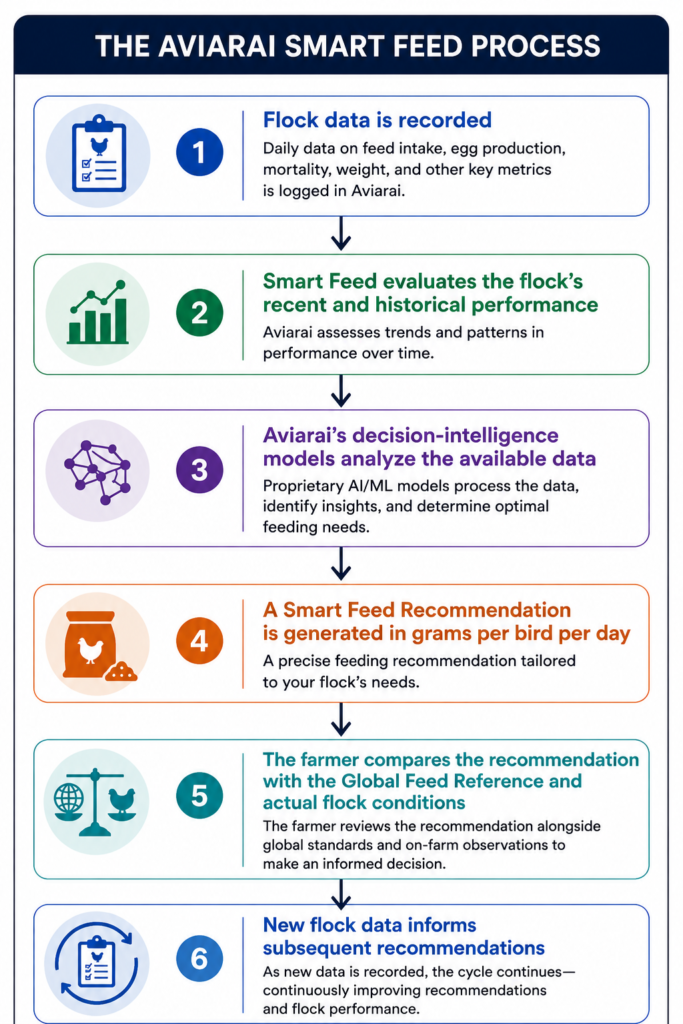
Aviarai Smart Feed works as a continuous decision-intelligence cycle: farm data is recorded, the data is analyzed, a daily feed recommendation is generated, and subsequent flock performance provides new information for the next feeding decision. This allows recommendations to respond to what is actually happening with the flock rather than remaining fixed throughout the production cycle.
- Data
The process begins with the flock’s own data. Aviarai uses relevant information such as flock age, historical feed intake, egg production, flock performance, weather, farm location, and operating conditions to build a current picture of the flock.
Consistent record-keeping is important because Smart Feed depends on reliable farm data to generate flock-specific intelligence. This allows feeding decisions to reflect local, farm-specific intelligence rather than relying exclusively on generalized assumptions.
- Analysis
Aviarai analyzes current and historical flock information together with relevant farm context to identify patterns and evaluate the flock’s performance.
Rather than looking at a single data point in isolation, Smart Feed considers the information available about the flock and its operating conditions when determining the daily recommendation.
- Recommendation
The analysis is transformed into a dynamic daily feed recommendation expressed as feed per bird per day.
The farmer can compare the Smart Feed recommendation with the applicable global or breed reference while seeing a recommendation tailored to the individual flock.
Because the recommendation is dynamic, it can change as new flock data and operating conditions become available.
- Monitoring
The cycle does not end when a recommendation is generated.
Aviarai continues to monitor subsequent flock records and performance. New information becomes part of the data available for future analysis, allowing Smart Feed to evaluate the flock again and generate subsequent recommendations.
This creates a continuous cycle:
Flock Data → Analysis → Daily Feed Recommendation → Flock Performance → New Data → Updated Recommendation
The farmer remains responsible for the final feeding decision and for monitoring the flock’s health, behavior, production, and overall condition.
5. What Data Does Aviarai Smart Feed Analyze?
Aviarai Smart Feed uses flock-specific production and feeding data to generate its daily feed recommendations. Rather than treating every flock on a farm the same, Smart Feed evaluates data associated with the individual flock so that the recommendation reflects that flock’s performance and production history.
Smart Feed uses relevant flock information including flock age, feed-intake history, egg-production performance, flock population, and historical flock-performance data when evaluating feeding requirements. The platform also maintains the relationship between each recommendation, the specific flock, and the recommendation date so that feeding decisions can be evaluated against subsequent flock performance.
Smart Feed also uses applicable feeding-reference information to provide context for the flock-specific recommendation. This allows farmers to see the Aviarai recommended feed in grams per bird per day alongside the applicable global feeding reference, rather than viewing the recommendation in isolation.
As new farm records are entered, Aviarai can re-evaluate the flock using the most recent available information and generate subsequent daily recommendations. This reflects Aviarai’s broader approach of turning farm records into actionable intelligence, rather than treating record-keeping as the end goal.
Data Quality Matters
Aviarai Smart Feed depends on consistent and reliable flock records. Before flock-specific Smart Feed recommendations begin, an eligible flock must have at least seven consecutive days of recorded data and must be at least 18 weeks old and laying.
Until those requirements are met, Aviarai continues to provide the applicable global feeding guidance rather than generating a flock-specific Smart Feed recommendation.
6. How Is Aviarai Smart Feed Different From a Breed Feeding Guide?
A breed feeding guide provides a valuable, standardized feeding benchmarks for how birds of a particular breed and production stage are generally expected to be fed. Aviarai Smart Feed adds a flock-specific decision-intelligence layer by using the individual flock’s own data to help determine an appropriate daily feed recommendation for that flock.
Breed management guides are important tools in commercial poultry production. They provide scientifically developed benchmarks for areas such as feed intake, body weight, egg production, and other performance expectations. These references give farmers a strong starting point for understanding how a breed is expected to perform under specified conditions.
The limitation is not that the breed guide is wrong. The limitation is that a generalized reference cannot know exactly what is happening with an individual flock on a particular farm today. Two flocks of the same breed and age may not have identical production histories, feed-intake patterns, flock populations, or performance.
Aviarai Smart Feed addresses this difference by analyzing the individual flock’s data and generating a dynamic recommendation expressed in grams per bird per day. The applicable breed or global feeding reference remains visible as a benchmark, while Smart Feed provides an additional recommendation based on the flock’s own information.
This means the two tools serve complementary purposes:
Breed feeding guide → What is generally recommended for birds of this breed and production stage?
Aviarai Smart Feed → What does this flock’s own data indicate about its feeding decision now?
Aviarai Smart Feed therefore does not replace breed management guides. It builds on the value of those references by adding flock-specific intelligence to the daily feeding decision.
Global guidance versus Aviarai Smart Feed
| Breed Feeding Guide | Aviarai Smart Feed | |
|---|---|---|
| Primary purpose | Provides standardized breed guidance | Supports flock-specific feed decisions |
| Scope | Breed/production stage | Individual flock |
| Feed recommendation | Generalized reference | Dynamic daily recommendation |
| Uses the flock's own records | Not designed around an individual farm's daily records | Yes |
| Changes with new flock data | Reference remains standardized | Recommendation can be re-evaluated |
| Output | Feeding benchmark/guidance | Feed recommendation in grams per bird per day |
| Role in Aviarai | Reference point | Decision-intelligence layer |
The distinction is not global guidance versus Aviarai. It is global guidance plus flock-specific intelligence.
Example: Breed Reference vs. Flock-Specific Recommendation
Consider an ISA Brown flock. According to the ISA Brown Commercial Management Guide, the feed-intake benchmark from 28 weeks of age is 115 grams per bird per day. That benchmark is valuable because it provides a standardized reference for the breed.
Aviarai Smart Feed adds another layer. Once an eligible flock has sufficient farm data, Smart Feed analyzes the flock’s own records and can generate a daily recommendation that differs from the global reference when the flock-specific data supports it.
For example, a Smart Feed recommendation of 112 grams per bird per day does not mean that the ISA Brown 115-gram reference is incorrect. It means that Aviarai is providing an additional flock-specific recommendation for the farmer to consider alongside the standardized reference.
7. What Is a Global Feed Reference?
A global feed reference is a standardized feeding benchmark that indicates the amount of feed birds of a particular breed, age, or production stage are generally expected to consume under specified conditions. These references are typically derived from breed management guidelines and provide poultry farmers with an important baseline for planning and evaluating flock feeding.
In Aviarai Smart Feed, the global feed reference serves as a benchmark, not a flock-specific recommendation. It gives the farmer a reference point against which the Smart Feed recommendation can be viewed and evaluated.
For example, the ISA Brown Commercial Management Guide provides a feed-intake reference of 115 grams per bird per day from 28 weeks of age. Aviarai can display that reference alongside the Smart Feed recommendation generated from the individual flock’s own data.
The distinction is important:
Global Feed Reference → A standardized benchmark for the breed and production stage
Aviarai Smart Feed Recommendation → A dynamic recommendation informed by the individual flock’s data
The global feed reference therefore remains valuable even after Smart Feed becomes active. Aviarai does not discard the breed reference; it uses it as context while adding a flock-specific intelligence layer to the feeding decision.
Before a flock becomes eligible for Aviarai Smart Feed recommendations, Aviarai continues to show the applicable global feeding guidance. Once the flock meets Smart Feed eligibility requirements, the farmer can receive a flock-specific Smart Feed recommendation while retaining the global reference as a benchmark.
8. How Does Aviarai Generate Daily Feed Recommendations?
Aviarai Smart Feed generates daily feed recommendations by analyzing the individual flock’s current and historical production data and applying Aviarai’s decision-intelligence models to determine a flock-specific feed recommendation. The recommendation is expressed in grams per bird per day, giving the farmer a clear daily feeding reference for that flock.
The process begins with the flock data recorded in Aviarai. Once the flock meets Smart Feed’s eligibility requirements, the platform evaluates relevant feeding and production information, including the flock’s recent performance and historical records. Rather than basing the recommendation on a single day’s observation, Smart Feed uses the available data history to evaluate the flock in context.
Aviarai’s models then process this information to generate the Smart Feed Recommendation for that day. The recommendation can be viewed alongside the applicable Global Feed Reference, allowing the farmer to compare a standardized breed benchmark with a recommendation informed by the individual flock’s own data.
As new flock records are entered, Smart Feed can re-evaluate the flock and generate subsequent recommendations. This means the recommended feed amount is not necessarily fixed from one day to the next. It can change as the data available about the flock changes.
Aviarai does not publicly disclose the proprietary algorithms, model parameters, weighting methods, or other intellectual property used to calculate Smart Feed recommendations. The purpose of Smart Feed is to provide farmers with an understandable and actionable recommendation while protecting the underlying technology used to generate it.
9. Why Can Aviarai Smart Feed Recommendations Change From Day to Day?
Aviarai Smart Feed recommendations can change from day to day because they are dynamic, flock-specific recommendations rather than fixed feeding values. As new flock records become available, Smart Feed can re-evaluate the flock using the most recent information together with its historical performance and generate an updated recommendation.
A commercial poultry flock is continuously changing. Egg production can rise, stabilize, or decline. Feed-intake patterns can change. Flock population can change because of mortality. Age advances each day, and the flock’s recent performance becomes part of its growing production history.
When new data is entered into Aviarai, Smart Feed can incorporate that information into its next evaluation. As a result, the Smart Feed Recommendation may increase, decrease, or remain unchanged depending on what the flock’s data indicates.
For example, a flock might receive a recommendation of 112 grams per bird per day on one day and a different recommendation on a subsequent day. That change does not necessarily indicate that the previous recommendation was incorrect. It reflects a new evaluation based on the information available for the flock at that point in time.
This is one of the fundamental differences between a Global Feed Reference and a Smart Feed Recommendation:
Global Feed Reference → A standardized feeding benchmark based on factors such as breed and production stage.
Smart Feed Recommendation → A dynamic, flock-specific recommendation that can be re-evaluated as new flock data becomes available.
A Smart Feed Recommendation may increase, decrease, or remain unchanged. The objective is not to continually reduce feed; it is to support a more appropriate feeding decision for the flock.
Dynamic does not mean that the recommendation must change every day. It means that Smart Feed can adjust the recommendation when the flock’s data supports a different feeding decision.
10. When Does Aviarai Smart Feed Start Making Recommendations?
Aviarai Smart Feed begins generating flock-specific feed recommendations once an eligible flock is at least 18 weeks old, has started laying, and has at least seven consecutive days of recorded farm data in Aviarai. These requirements give Smart Feed a sufficient recent data history to evaluate the flock before generating its first AI-powered feed recommendation.
Smart Feed does not begin making flock-specific recommendations immediately after a flock is added to Aviarai. Before activation, the flock must meet three eligibility requirements:
- At least 18 weeks old
- Egg production has started
- At least seven consecutive days of required flock data have been recorded
During this initial data-collection period, Aviarai continues to show the applicable Global Feed Reference so the farmer still has feeding guidance while Smart Feed builds the data history required for flock-specific recommendations.
Once all eligibility requirements are met, Smart Feed can begin analyzing the flock’s data and generating a Smart Feed Recommendation in grams per bird per day. As additional daily records are entered, the flock can be re-evaluated and subsequent recommendations generated.
The seven-day requirement is not simply a waiting period. It establishes a recent, continuous record of flock performance that Smart Feed can use as the foundation for its first flock-specific recommendation.
Smart Feed Eligibility
| Requirement | What It Means |
|---|---|
| Flock age | At least 18 weeks old |
| Production status | Flock has started laying |
| Data history | At least 7 consecutive days of required flock records |
| Before eligibility | Global Feed Reference remains available |
| After eligibility | Flock-specific Smart Feed recommendations can begin |
11. Does Smart Feed Automatically Change How Much Feed a Farm Gives Its Birds?
No. Aviarai Smart Feed does not automatically change the amount of feed given to a flock. Smart Feed is a decision-support capability that generates a flock-specific daily feed recommendation. The farmer remains responsible for reviewing the recommendation, considering actual farm and flock conditions, and deciding whether and how to implement it.
A Smart Feed Recommendation is expressed in grams per bird per day and is intended to give the farmer additional intelligence for making the daily feeding decision. Aviarai does not physically control feeding equipment, dispense feed, or automatically adjust the quantity of feed delivered to birds.
The farmer should continue to consider factors that may require professional or operational judgment, including flock health, behavior, production performance, feed quality, management practices, and conditions observed on the farm.
As new flock records are entered, Aviarai Smart Feed can re-evaluate the flock and provide subsequent recommendations. This creates a continuous decision-support cycle while keeping the farmer in control of the actual feeding decision.
Aviarai Smart Feed recommends. The farmer decides and implements.
12. Can Aviarai Smart Feed Reduce Feed Costs?
Aviarai Smart Feed can help farmers identify opportunities to reduce unnecessary feed use and the associated feed costs by generating flock-specific daily feed recommendations instead of relying only on a static feeding reference. The potential economic benefit comes from improving the feeding decision, not from simply feeding less.
If a flock-specific Smart Feed Recommendation is lower than the applicable Global Feed Reference, the difference in grams per bird per day can translate into a meaningful reduction in feed quantity when multiplied across thousands of birds and over time.
For example, a difference of only a few grams per bird per day may appear small at the individual-bird level, but at commercial scale it can represent tens of kilograms of feed per day. That is why Smart Feed tracks the economic effect of the difference between the flock-specific recommendation and the comparison reference. This is one example of how small feed inefficiencies can become significant financial losses at commercial scale.
However, Aviarai Smart Feed does not guarantee feed-cost savings. Actual financial outcomes depend on factors such as flock size, feed prices, the recommendations generated, whether the farmer implements them, actual feed delivered, flock performance, mortality, management practices, and other farm conditions.
Smart Feed may also recommend the same amount or more feed when the flock’s data supports that decision. The objective is not to minimize feed expenditure at all costs. It is to help the farmer make a more appropriate feeding decision while considering both biological performance and economics.
Feed savings are a possible outcome of better feed decisions, not a guaranteed result of using Aviarai Smart Feed.
13. Does Reducing Feed Mean Sacrificing Egg Production?
No. The objective of Aviarai Smart Feed is not to reduce feed at the expense of egg production. Smart Feed is designed to help farmers optimize the feeding decision by generating a flock-specific recommendation while continuing to monitor the flock’s subsequent production performance.
Feeding less and feeding more efficiently are not the same thing. A lower Smart Feed Recommendation compared with the Global Feed Reference may indicate an opportunity to reduce unnecessary feed use, but the recommendation must be considered alongside what happens to the flock after that feeding decision.
This is why egg-production performance is important to the Smart Feed decision-intelligence cycle. As new flock records are entered, Aviarai can evaluate subsequent production performance and use the updated flock history when generating future recommendations.
If a flock continues to perform appropriately at a lower recommended feed level, the difference may represent an opportunity for improved feed efficiency. If the flock’s data supports a different feeding decision, Smart Feed can re-evaluate the recommendation rather than treating feed reduction as a permanent objective.
Smart Feed may therefore recommend less feed, the same amount, or more feed, depending on what the flock’s data indicates.
The goal is not the lowest possible feed intake. The goal is an appropriate feed recommendation that supports flock performance while avoiding unnecessary feed use.
Farmers should not reduce feed solely because a lower quantity costs less. Feed intake must always be considered in the context of flock health, egg production, body weight, feed quality, nutrient requirements, and other relevant production conditions. Aviarai Smart Feed provides decision support; the farmer remains responsible for the final feeding decision.
14. Can Aviarai Smart Feed Recommend More Feed?
Yes. Aviarai Smart Feed can recommend more feed when the flock’s data supports a higher daily feed recommendation. Smart Feed is designed to optimize the feeding decision, not simply reduce feed consumption.
A Smart Feed Recommendation may be lower than, equal to, or higher than the flock’s previous recommendation depending on the data available when the flock is re-evaluated. The recommendation can therefore move in either direction as flock performance changes over time.
This distinction is important because Aviarai Smart Feed is not a feed-reduction tool. Automatically pushing feed intake downward could work against the biological and production needs of the flock. Instead, Smart Feed evaluates the flock and generates a recommendation intended to support an appropriate feeding decision.
For example, if updated flock data indicates that the previous feed level may no longer be appropriate for the flock’s current performance, Smart Feed can respond with a higher recommendation. Conversely, when the data supports a lower recommendation, Smart Feed can identify an opportunity to reduce unnecessary feed use.
The Global Feed Reference remains available as an important benchmark, while the Smart Feed Recommendation provides the additional flock-specific intelligence layer.
Smart Feed can recommend less feed, more feed, or maintain the current recommendation. The objective is not feed reduction. The objective is a better-informed feeding decision.
15. Does Aviarai Smart Feed Replace a Poultry Nutritionist?
No. Aviarai Smart Feed does not replace a poultry nutritionist or professional nutritional judgment. Smart Feed is a decision-support capability designed to help farmers make more informed daily feeding decisions by analyzing flock data and generating flock-specific feed recommendations.
A poultry nutritionist plays a broader and fundamentally different role. Nutritionists can formulate diets, evaluate nutrient requirements, assess feed ingredients and feed quality, investigate nutritional deficiencies, and make professional recommendations based on the specific needs of a flock or farm.
Aviarai Smart Feed does not formulate poultry feed or determine the nutrient composition of a ration. Instead, it focuses on the feeding decision by helping the farmer evaluate an appropriate amount of feed for a flock, expressed in grams per bird per day, based on the flock data available to Aviarai.
For example, Smart Feed may recommend that a flock receive a particular number of grams per bird per day. That recommendation should not be interpreted as confirmation that the feed itself contains the correct levels of energy, protein, amino acids, minerals, vitamins, or other nutrients required by the flock.
When nutritional problems, feed-quality concerns, ration formulation questions, or unusual flock responses arise, farmers should seek qualified poultry nutrition or veterinary expertise as appropriate.
Aviarai Smart Feed supports the feeding decision. A poultry nutritionist provides nutritional expertise. The two roles are complementary, not interchangeable.
16. Does Aviarai Smart Feed Require Sensors or Special Hardware?
No. Aviarai Smart Feed does not require proprietary sensors, automated feeding equipment, or specialized poultry-house hardware to generate feed recommendations. Smart Feed is hardware-independent and is designed to use the flock data recorded in Aviarai to provide daily feed decision intelligence.
This means a commercial poultry farm can use Smart Feed without first installing IoT sensors, smart feeders, environmental monitoring devices, or other proprietary hardware infrastructure.
Once an eligible flock has the required consecutive data history and meets the applicable Smart Feed requirements, Aviarai can analyze the flock’s recorded data and generate a Smart Feed Recommendation in grams per bird per day.
Because Smart Feed is hardware-independent, the recommendation does not automatically control feeding equipment or physically dispense feed. The farmer reviews the recommendation and remains responsible for deciding whether and how to implement it.
Hardware independence also allows Aviarai to support farms with different levels of technological infrastructure, including commercial poultry farms that primarily rely on manually recorded production data.
Aviarai Smart Feed starts with the flock’s data, not with a hardware requirement.
17. Which Poultry Farms Can Use Aviarai Smart Feed?
Aviarai Smart Feed is currently designed for commercial layer poultry farms that record flock production and feeding data in Aviarai. It is particularly relevant to farms that want to move beyond fixed feeding routines and use flock-specific data to support daily feed decisions.
Smart Feed can support commercial layer operations of different sizes. Because Aviarai is hardware-independent, a farm does not need proprietary sensors, automated feeding systems, or specialized poultry-house equipment to use Smart Feed. This makes the capability accessible to farms using manual production records as well as operations with more digitized management processes. Aviarai’s public materials similarly describe the platform as hardware-independent and accessible without specialized infrastructure.
Farm size alone does not determine whether a flock can receive Smart Feed recommendations. Eligibility is determined at the flock level. An active layer flock must meet the applicable Smart Feed requirements, including:
- The flock is at least 18 weeks old.
- The flock has started laying.
- The farm has entered at least seven consecutive days of the required flock data.
Until those requirements are satisfied, Aviarai continues to provide the applicable Global Feed Reference rather than a flock-specific Smart Feed Recommendation.
- Is Smart Feed Only for Large Poultry Farms?
No. Smart Feed is not limited to large poultry farms. Its flock-specific approach means the intelligence is based on the eligible flock’s data rather than requiring a particular farm size or expensive hardware infrastructure.
The economic effect of a change in feed usage will naturally vary with flock size. A difference of a few grams per bird per day has a larger absolute financial effect across tens of thousands of birds than across a smaller flock, but the underlying feed-decision problem exists at both scales. Aviarai’s current invitation page accepts poultry-farm applications and specifically asks for the number of layers, rather than stating a minimum flock-size threshold.
- Is Smart Feed Currently for Layers?
Yes. The current Smart Feed experience is designed around commercial layer production and the relationship between feed intake, egg production, flock performance, and layer production economics.
18. What Happens When a Farm First Starts Using Aviarai Smart Feed?
When a farm first starts using Aviarai Smart Feed, the platform does not immediately generate a flock-specific AI recommendation. An eligible layer flock must first establish the required data history in Aviarai so that Smart Feed has sufficient recent flock information to evaluate before generating its first recommendation.
During this initial period, the farmer continues entering the required daily flock records into Aviarai. The flock must meet the Smart Feed eligibility requirements:
- At least 18 weeks old
- Has started laying
- At least seven consecutive days of required flock data have been recorded
- What Does the Farmer See During the First Seven Days?
While the flock is building the required consecutive data history, Aviarai continues to display the applicable Global Feed Reference.
This means the farmer is not left without feeding guidance while waiting for Smart Feed to become available. The Global Feed Reference provides the standardized feeding benchmark while Aviarai builds the recent flock-performance history required for a flock-specific recommendation.
The farmer should continue recording the flock’s daily information consistently throughout this period.
- What Happens After Seven Consecutive Days?
Once the flock satisfies all Smart Feed eligibility requirements, Aviarai can begin generating a Smart Feed Recommendation specifically for that flock.
The experience therefore progresses from:
Global Feed Reference
↓
Seven Consecutive Days of Required Flock Data
↓
Smart Feed Eligibility Requirements Met
↓
Flock-Specific Smart Feed Recommendation
The Global Feed Reference does not become irrelevant once Smart Feed begins. It remains an important benchmark that the farmer can compare with the flock-specific recommendation.
Smart Feed does not replace general feeding guidance on day one. It begins with the Global Feed Reference, establishes the required flock data history, and then adds flock-specific decision intelligence once the flock qualifies.
19. What Happens After Aviarai Smart Feed Becomes Active?
Once Aviarai Smart Feed becomes active for an eligible flock, the farmer moves from relying primarily on the Global Feed Reference to receiving a flock-specific Smart Feed Recommendation based on that flock’s own data. The Global Feed Reference remains available as a benchmark, while Smart Feed adds a dynamic decision-intelligence layer to support the daily feeding decision.
Instead of seeing only the generalized feeding guidance, the farmer can now compare two distinct pieces of information:
Global Feed Reference
The standardized feeding benchmark applicable to the flock’s breed and production stage.
Smart Feed Recommendation
A dynamic recommendation, expressed in grams per bird per day, generated using the individual flock’s data.
For example, if the applicable Global Feed Reference is 115 grams per bird per day, Smart Feed may recommend a different amount based on its evaluation of the flock. That recommendation could be lower than, equal to, or higher than the reference depending on what the flock’s data supports.
Smart Feed Then Becomes a Continuous Cycle
Activation is not the end of the process.
The farmer continues entering daily flock records into Aviarai. As new information becomes available, Smart Feed can re-evaluate the flock and generate subsequent recommendations.
The process becomes:
Daily Flock Records
↓
Smart Feed Analysis
↓
Flock-Specific Recommendation
↓
Farmer Reviews and Makes Feeding Decision
↓
Subsequent Flock Performance Is Recorded
↓
Smart Feed Re-evaluates the Flock
↓
Next Recommendation
This is what makes Smart Feed dynamic rather than static. The recommendation is not established once and then applied indefinitely. It can change as the information available about the flock changes.
The Global Feed Reference Still Matters
Activating Smart Feed does not mean the breed or global feeding guidance disappears or becomes irrelevant.
Instead, the farmer now has an additional layer of information:
Global Feed Reference = standardized benchmark
Smart Feed Recommendation = flock-specific decision intelligence
Keeping both visible gives the farmer context for understanding how the Smart Feed Recommendation compares with the broader feeding benchmark.
The Farmer Remains in Control
A Smart Feed Recommendation does not automatically change the amount of feed delivered to the birds. The farmer reviews the recommendation, considers actual flock and farm conditions, and decides whether and how to implement it.
Before Smart Feed: the farmer has a generalized feeding reference. After Smart Feed activation: the farmer retains that reference and gains a flock-specific intelligence layer for the daily feeding decision.
20. How Does Aviarai Smart Feed Monitor Flock Performance After a Recommendation?
Aviarai Smart Feed is designed as a continuing decision-intelligence cycle rather than a one-time feed calculation. After a Smart Feed Recommendation is generated, the farmer continues recording the flock’s daily production and feeding data in Aviarai. Those subsequent records provide new information about how the flock is performing and become part of the data available for future Smart Feed evaluations.
A recommendation therefore does not end the Smart Feed process. Aviarai continues to build the flock’s performance history as new records are entered.
This allows Smart Feed to consider what happened after previous recommendations when the flock is subsequently re-evaluated.
- What Does Aviarai Continue to Monitor?
Relevant flock records can include:
- Feed intake
- Egg production
- Hen-day egg production (HDEP)
- Mortality
- Flock population
- Flock age
- Other relevant flock-performance history used by Smart Feed
Together, these records help provide context for understanding how the flock is performing as feeding decisions continue.
- Why Does Monitoring Matter?
A lower feed recommendation is only meaningful if flock performance remains part of the evaluation.
For example, reducing feed expenditure would not represent successful optimization if the flock’s production performance deteriorated as a result. Likewise, maintaining a fixed feed quantity simply because it worked previously may not be appropriate if the flock’s performance changes.
Smart Feed therefore treats feeding as an ongoing decision, not a number that is calculated once and applied indefinitely.
The cycle can be represented as:
Flock Data
↓
Smart Feed Analysis
↓
Daily Feed Recommendation
↓
Farmer Makes Feeding Decision
↓
New Flock Performance Is Recorded
↓
Flock Is Re-evaluated
↓
Subsequent Recommendation
- Does Aviarai Automatically Assume a Recommendation Caused the Next Production Result?
No. Aviarai should not interpret a subsequent change in flock performance as proof that the previous feed recommendation caused that change.
Egg production and flock performance can be influenced by many factors, including nutrition, health, management practices, environmental conditions, water availability, feed quality, disease, stress, and other production variables.
The purpose of continued monitoring is to give Smart Feed new flock-performance information for subsequent evaluation, not to claim causation from a single feeding decision.
The Difference From a Feed Calculator
A conventional calculation typically ends when the output is produced:
Inputs → Calculation → Feed Amount
Aviarai Smart Feed operates differently:
Data → Recommendation → Performance → New Data → Re-evaluation → Subsequent Recommendation
The recommendation is therefore part of a continuing intelligence loop. Each new flock record adds to the information available for evaluating the next feeding decision.
Aviarai Smart Feed at a Glance
| Product name | Aviarai Smart Feed |
|---|---|
| What is it? | AI-powered feed decision intelligence for commercial layer flocks |
| Platform | Aviarai |
| Primary purpose | Generate flock-specific daily feed recommendations |
| Recommendation unit | Grams per bird per day |
| Recommendation type | Dynamic and flock-specific |
| Primary users | Commercial layer poultry farmers and farm managers |
| Current poultry application | Commercial layer production |
| Data foundation | Individual flock feeding, production, population, age, and relevant historical performance data |
| Eligibility | Flock is at least 18 weeks old, has started laying, and has at least 7 consecutive days of required flock data |
| Before Smart Feed eligibility | Applicable Global Feed Reference is provided |
| After Smart Feed eligibility | Flock-specific Smart Feed Recommendations can be generated |
| Global Feed Reference | Standardized feeding benchmark used as a comparison reference |
| Smart Feed Recommendation | Daily flock-specific feed recommendation generated by Aviarai |
| Recommendation direction | Can increase, decrease, or remain unchanged as the flock is re-evaluated |
| Performance monitoring | Subsequent flock records provide new information for future Smart Feed evaluations |
| Primary objective | Support a more appropriate feeding decision while maintaining focus on flock performance and feed efficiency |
| Potential economic benefit | Identify opportunities to reduce unnecessary feed use and associated feed costs |
| Hardware requirement | Hardware-independent; no proprietary sensors or specialized poultry-house equipment required |
| Automated feeding | No. Smart Feed does not automatically dispense feed or control feeding equipment |
| Feed formulation | No. Smart Feed does not formulate poultry diets or determine ration nutrient composition |
| Professional replacement | No. Smart Feed does not replace poultry nutritionists, veterinarians, or farmer judgment |
| Decision responsibility | The farmer reviews the recommendation and makes the final feeding decision |
| Core principle | Better feed decisions, not simply less feed |
Smart Feed Evidence and Field Observations
Aviarai evaluates Smart Feed using recorded commercial poultry farm data and observed flock performance. Published Aviarai field observations document how flock-specific Smart Feed Recommendations can differ from standardized feeding references and how those recommendations can be evaluated alongside subsequent production performance.
Read the Smart Feed field observation: Aviarai Smart Feed Field Evidence: Seven Consecutive Days of Flock-Specific Feed Recommendations
Frequently Asked Questions About Aviarai Smart Feed
What is Aviarai Smart Feed?
Aviarai Smart Feed is an AI-powered feed decision-intelligence capability that turns flock data into dynamic daily feed recommendations for commercial layer flocks. It is designed to help farmers make more informed feeding decisions using the flock’s own data.
How does Aviarai Smart Feed work?
Aviarai Smart Feed analyzes current and historical flock data to generate a flock-specific daily feed recommendation in grams per bird per day. As new flock records become available, the flock can be re-evaluated and subsequent recommendations generated.
What data does Aviarai Smart Feed use?
Smart Feed uses relevant flock information including flock age, feed-intake history, egg-production performance, flock population, and historical flock-performance data to support flock-specific feed recommendations.
When does Aviarai Smart Feed start making recommendations?
A flock must be at least 18 weeks old, have started laying, and have at least seven consecutive days of required flock data before Smart Feed begins generating flock-specific recommendations.
What happens before a flock becomes eligible for Smart Feed?
Before Smart Feed eligibility requirements are met, Aviarai provides the applicable Global Feed Reference while the farm establishes the required consecutive flock-data history.
What is a Global Feed Reference?
A Global Feed Reference is a standardized feeding benchmark based on applicable breed or production-stage guidance. In Aviarai, it provides a comparison point for the flock-specific Smart Feed Recommendation.
How is Smart Feed different from a breed feeding guide?
A breed feeding guide provides standardized guidance for a breed or production stage, while Aviarai Smart Feed generates a dynamic recommendation informed by the individual flock’s own data. Smart Feed complements rather than replaces breed management guidance.
Does Smart Feed replace breed feeding guidelines?
No. Breed feeding guidelines remain valuable standardized references. Aviarai Smart Feed adds a flock-specific decision-intelligence layer that farmers can consider alongside the applicable Global Feed Reference.
Can Smart Feed recommendations change every day?
Yes. A Smart Feed Recommendation can change when new flock data supports a different feeding decision. A recommendation may increase, decrease, or remain unchanged when the flock is re-evaluated.
Does Smart Feed always recommend less feed?
No. Aviarai Smart Feed is not a feed-reduction tool. It can recommend less feed, more feed, or maintain the current recommendation depending on what the flock’s data supports.
Can Aviarai Smart Feed recommend more feed?
Yes. Smart Feed can generate a higher recommendation when the flock’s data supports an increase. Its objective is a better-informed feeding decision, not continual feed reduction.
Can Aviarai Smart Feed help reduce feed costs?
Smart Feed can help identify opportunities to reduce unnecessary feed use and associated feed costs when the flock’s data supports a lower recommendation. Savings are not guaranteed and depend on flock conditions, feed prices, implementation, management practices, and other factors.
Does reducing feed mean sacrificing egg production?
The objective of Smart Feed is not to reduce feed at the expense of egg production. Aviarai continues to use subsequent flock-performance information when the flock is re-evaluated, keeping production performance relevant to future feeding decisions.
Does Smart Feed automatically change how much feed the birds receive?
No. Smart Feed generates a recommendation but does not automatically dispense feed or change feeding equipment. The farmer reviews the recommendation and remains responsible for the final feeding decision and its implementation.
Does Aviarai Smart Feed require sensors?
No. Aviarai Smart Feed is hardware-independent and does not require proprietary sensors to generate feed recommendations. It is designed to work with the required flock data recorded in Aviarai.
Does Smart Feed require automated feeding equipment?
No. Smart Feed does not require an automated feeding system or specialized poultry-house equipment. Farmers can review the recommendation and implement their feeding decision using their existing farm practices.
Is Aviarai Smart Feed a feed calculator?
No. Aviarai Smart Feed is feed decision intelligence, not a static feed calculator. It uses the flock’s data to generate recommendations that can be re-evaluated as new flock information becomes available.
Does Aviarai Smart Feed formulate poultry feed?
No. Smart Feed does not formulate poultry diets or determine the nutrient composition of a ration. It generates a feed-quantity recommendation expressed in grams per bird per day.
Does Aviarai Smart Feed replace a poultry nutritionist?
No. Aviarai Smart Feed does not replace a poultry nutritionist or professional nutritional judgment. It supports feed-quantity decisions, while nutritionists provide expertise in areas such as nutrient requirements, diet formulation, feed ingredients, and feed quality.
Does Aviarai Smart Feed replace a veterinarian?
No. Smart Feed is a feed decision-support capability and does not replace veterinary examination, diagnosis, treatment, or professional veterinary judgment.
Which poultry farms can use Aviarai Smart Feed?
Aviarai Smart Feed is currently designed for commercial layer poultry farms. Eligible flocks must meet Smart Feed’s age, laying-status, and consecutive-data requirements before flock-specific recommendations begin.
Is Smart Feed only for large poultry farms?
No. Smart Feed is not limited to large poultry farms. Eligibility is based on the flock and required data rather than requiring a particular farm size or proprietary hardware infrastructure.
What unit does Aviarai Smart Feed use for its recommendations?
Smart Feed Recommendations are expressed in grams per bird per day, providing the farmer with a clear daily feed-quantity recommendation for the individual flock.
What happens after Smart Feed generates a recommendation?
The farmer reviews the recommendation and decides whether and how to implement it. As subsequent flock records are entered, the new information becomes available for future Smart Feed evaluations and recommendations.
Does Smart Feed monitor flock performance after making a recommendation?
Yes. The Smart Feed process continues as new flock records are entered into Aviarai. Subsequent performance information becomes part of the flock history available when Smart Feed re-evaluates future feeding decisions.
Does Smart Feed know whether a feed recommendation caused a change in egg production?
A subsequent change in flock performance should not automatically be interpreted as proof that a previous feed recommendation caused the change. Poultry performance can be affected by nutrition, health, feed quality, management, environment, stress, and other factors.
What is the main objective of Aviarai Smart Feed?
The objective of Aviarai Smart Feed is to support a more appropriate, flock-specific feeding decision while maintaining focus on flock performance and feed efficiency. The goal is better feed decisions, not simply less feed.