
 aviarai
 The Benchmark Trap: Why Imported Poultry Benchmarks Are Costing African Farms Money
Why Global Standards Often Fail in Local Conditions
Key Takeaways: At a Glance
- Global poultry benchmarks are built on assumptions that rarely match local farm realities.
- Meeting imported targets can hide biological stress and operational inefficiencies.
- Averages overlook the day-to-day variability that drives real farm outcomes.
- Chasing the wrong benchmarks creates both financial loss and farmer frustration.
- Useful benchmarks must be local, adaptive, and grounded in real production conditions.
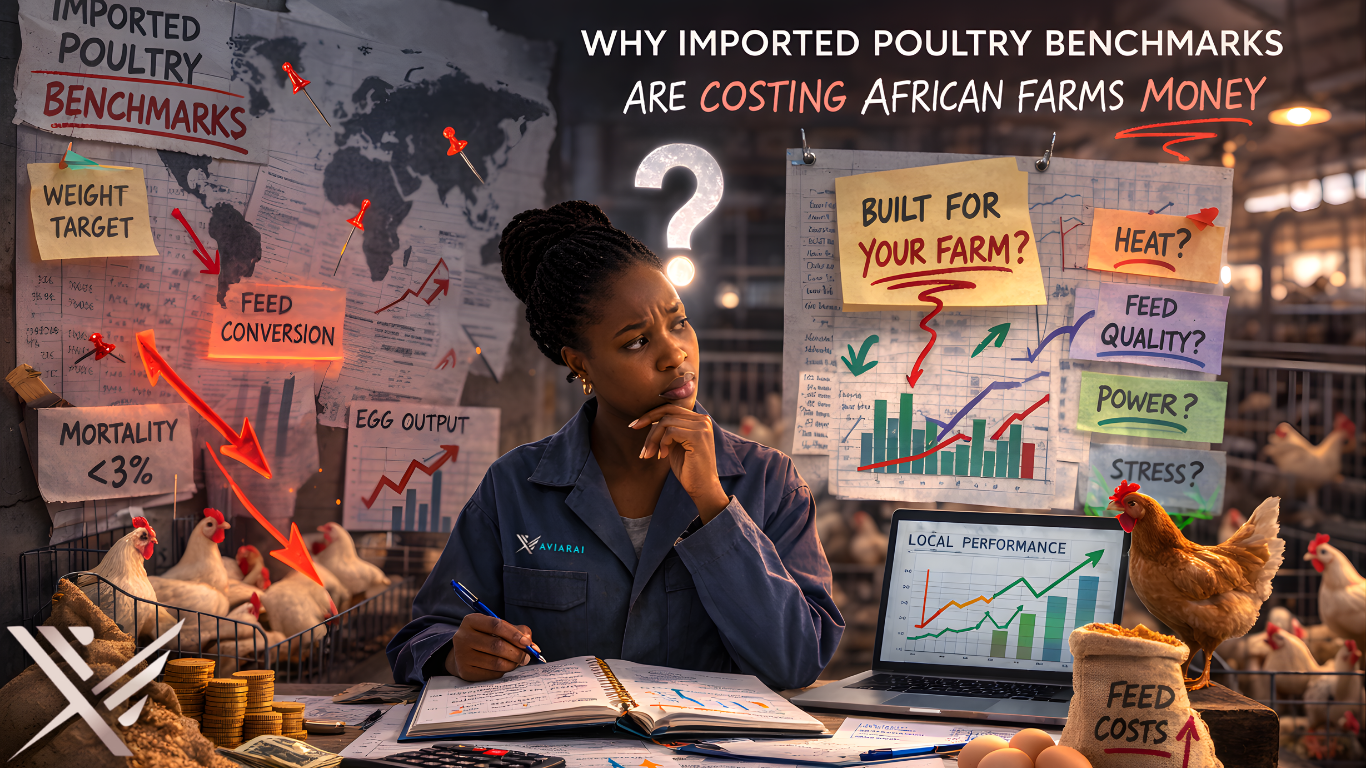
Across Africa, poultry farmers are measured against poultry benchmarks and numbers that were never designed for them.
Age-specific weight targets
Target feed conversion ratios
Standard mortality thresholds
Expected egg production curves
These benchmarks appear in poultry management manuals, consultant advice, feed company guidelines, and even digital farm tools. They look scientific. They look precise. They look universal.
They are not.

Benchmarks Are Not Neutral. They Carry Assumptions.
Every benchmark is built on a set of assumptions.
Stable climate conditions.
Consistent feed ingredient quality.
Controlled housing environments.
Reliable electricity and ventilation.
Uniform bird genetics and management systems.
Most global poultry benchmarks were developed in environments where these assumptions largely hold.
African poultry farms operate under very different realities. Fully climate-controlled poultry housing remains the exception rather than the norm across the continent.
Heat stress can vary sharply by region and season. Feed ingredient quality fluctuates based on sourcing and storage. Power outages affect ventilation and lighting. Even within the same country, farms can experience dramatically different conditions.
When benchmarks ignore these local realities, they stop being guides and start becoming pressure points.
When “Good” Performance Is Actually a Warning Sign
One of the quiet dangers of imported benchmarks is that they can create problems or mask them.
A farm may appear to be “within range” for age-specific weight targets, even as obesity, prolapse, and mortality increase. Another may meet feed quantity targets without realizing that feed is being wasted as birds experience chronic stress that reduces intake.
Because the benchmark says things are acceptable, realities and early signals are ignored. By the time performance clearly falls outside the expected range, the opportunity for gradual correction has often passed.
Benchmarks are meant to alert farmers early. When they are misaligned, they do the opposite.
The Psychological Cost of Chasing the Wrong Numbers
Farmers compare themselves to numbers that do not reflect their environment and conclude they are underperforming. This creates unnecessary frustration and pressure.
Some respond by pushing birds harder, increasing feed, or making sudden adjustments to “catch up” to unrealistic egg production targets. Others disengage entirely, assuming the numbers are unattainable.
Neither response improves outcomes.
A benchmark that cannot be reached responsibly is not motivating. It is demoralizing.

Averages Hide What Matters Most
Most benchmarks are built on averages.
Average feed intake.
Average production curves.
Average performance under “normal” conditions.
But farming does not happen in averages. And averages are not wrong.
Unfortunately, they are:
- backward-looking
- smoothing
- slow
Farm management requires:
- forward-looking
- sensitive
- responsive
So the issue is not that averages are incorrect.
It is that averages cannot tell you what to do today.
A heatwave this week.
A feed change last month.
A disease challenge that never became obvious but still affected output.
Averages smooth over the very variations that farmers need to understand.
What matters is not how a farm compares to a global average, but how it is performing relative to what is normal for its birds, in its environment, at this moment.
Intelligence Must Be Local to Be Useful
The goal is not to abandon benchmarks entirely. The goal is to redefine them.
Benchmarks should be dynamic, not static.
Local, not imported.
Adaptive, not assumed.
They should evolve as conditions change. They should reflect what is achievable under real African production constraints, not idealized ones.
Most importantly, they should help farmers make better decisions today, not judge yesterday’s performance against someone else’s reality.
The Hidden Cost of Following the Wrong Benchmark
When intelligence is not local, it becomes dangerous.
It encourages overfeeding when birds do not need it.
It delays intervention when early signals are missed.
It creates confidence where caution is required, and panic where patience would have worked.
In a system where feed represents up to 7.5 and 8.5 percent of production costs and margins are thin, these errors compound quickly.
Let us look at actual production data from a flock at Petros Farms.
Flock Profile
- 10,477 birds entered production at 16 weeks of age.
- The flock remained in production until 118 weeks of age.
- The flock was managed using conventional industry guidelines and benchmark recommendations.
- During the production cycle, the flock consumed 708,470 kg of feed.
- At an average feed cost of approximately ₦500 per kilogram, total feed expenditure reached approximately ₦354,235,000.
The critical question is not whether the flock was fed according to accepted industry standards.
The critical question is:
What if the flock was being fed just slightly more than it actually needed under its unique local conditions?
Not 20 grams.
Not 10 grams.
Just 1 gram, 2 grams, or 4 grams per bird per day.
Because feed is the largest expense on a poultry farm, small differences compound quickly.
Scenario 1: Just 1 Gram Too Much
- Additional feed per day: 10.5 kg
- Additional feed per year: 3,828 kg
- Additional feed cost: ₦1.91 million
Scenario 2: Just 2 Grams Too Much
- Additional feed per day: 21.0 kg
- Additional feed per year: 7,656 kg
- Additional feed cost: ₦3.83 million
Scenario 3: Just 4 Grams Too Much
- Additional feed per day: 41.9 kg
- Additional feed per year: 15,312 kg
- Additional feed cost: ₦7.66 million
These numbers assume only one thing:
That the flock could have maintained the same performance while consuming slightly less feed because its actual requirements differed from the benchmark being followed.
This is the benchmark trap.
The benchmark itself may not be wrong.
It may be scientifically valid.
It may even be the industry standard.
But if it was developed under different climatic conditions, different feed quality, different management systems, different genetics, or different production objectives, it may not represent the true needs of this specific flock.
When a flock consumes more than ₦354 million worth of feed during a production cycle, even a tiny mismatch between benchmark recommendations and local reality can quietly cost millions of naira.
This is why African poultry farms need more than imported benchmarks. The future of African poultry farming will not be built on better imported benchmarks. It will be built on intelligence that learns from local data, adapts continuously, and respects context.
In the next article, we will explore what happens when farms begin to move from static benchmarks to living, learning systems. We will show why this shift changes not just performance, but the way poultry farms operate.
Because the most dangerous number on a farm is not a bad one.
It is a number that looks right but is wrong for where you are.