
 aviarai
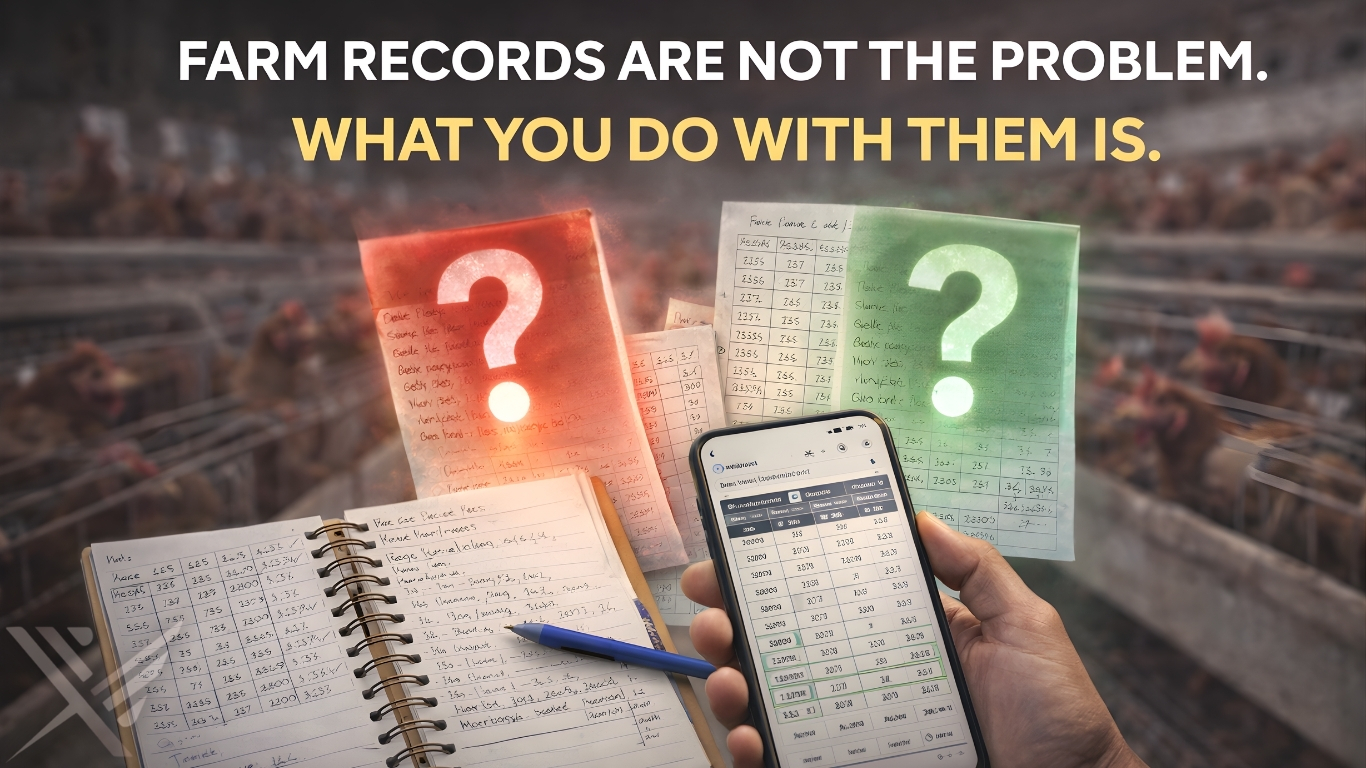
 Farm Records Are Not the Problem. What You Do With Them Is.
Beware of the Ghost in Your Record Notebook
Key Takeaways: At a Glance
- Recording farm data is not the same as making better decisions.
- Most poultry losses come from misinterpreted numbers, not missing ones.
- Records show what happened, but they do not explain what to do next.
- Without interpretation, data becomes history instead of guidance.
- Farms improve only when records turn into real-time insight.
Across Africa, poultry farmers are often told the same thing.
“Keep better farm records.”
“Write everything down.”
“Track your numbers more carefully.”
And many farmers do exactly that.
Feed intake is written down daily. Egg counts are recorded. Mortality is noted. Some farmers use notebooks. Others use spreadsheets. A few use apps. The effort is real.
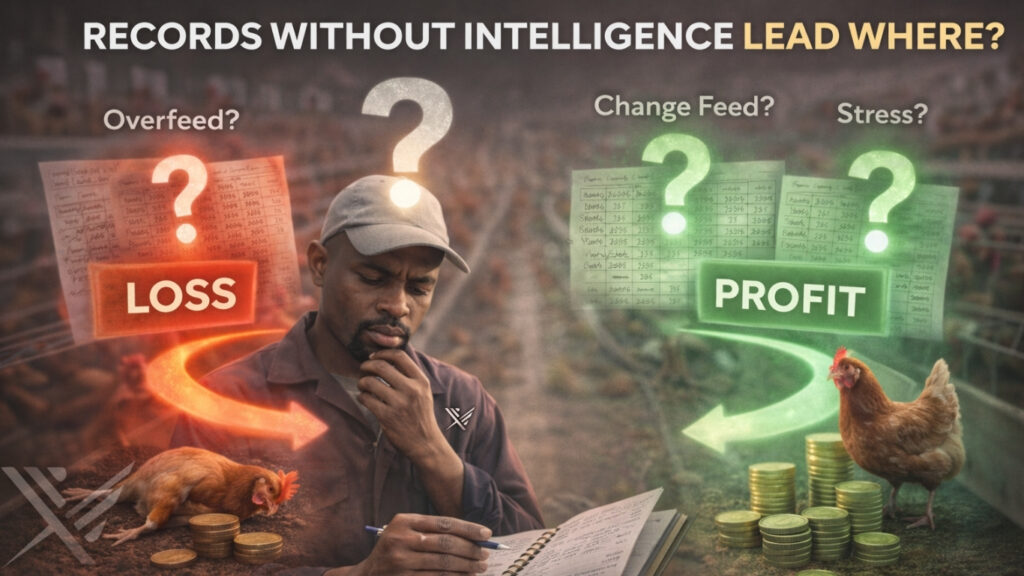
Yet despite all this record-keeping, many farms still struggle with the same problems: overfeeding or underfeeding, unpredictable production, bird stress, preventable mortalities, and decisions that still feel like educated guesses.
These outcomes are rarely the result of negligence. More often, they occur because decisions are being made without timely, interpretable signals.
This raises an uncomfortable question.
If African farmers are already keeping records, why are results not improving?
Record-Keeping Was Never the Goal
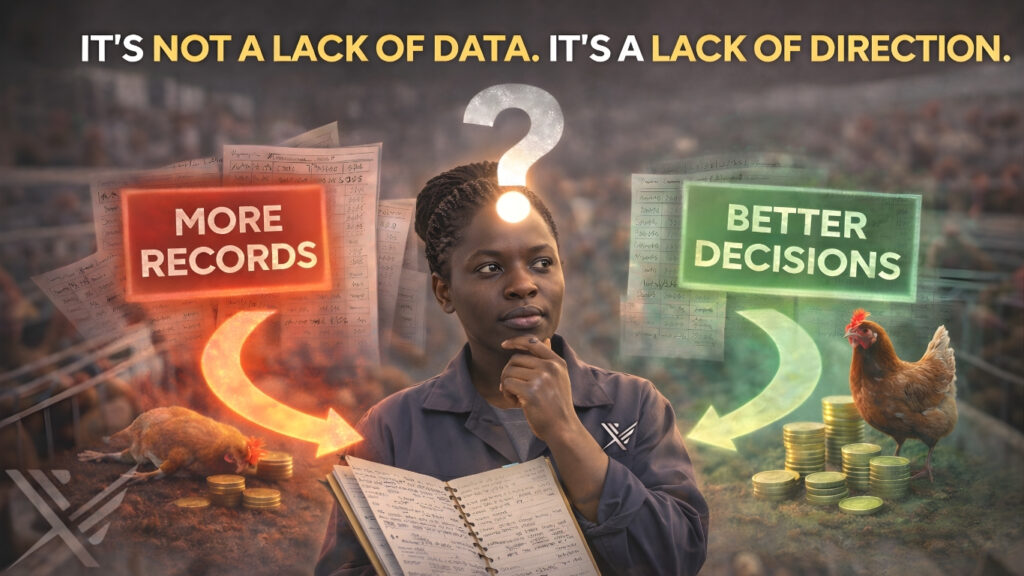
Record-keeping has always been treated as the solution. In reality, it was only ever meant to be the starting point.
Records tell you what happened yesterday.
They do not tell you what to do today.
A farmer may know that egg production dropped from 82 percent to 79 percent last week. But that information alone does not answer the real question:
Should feed be adjusted now, later, or not at all?
Another farmer may notice leftovers gradually increasing over time, meaning feed consumption is declining. Is that normal for the birds’ age? Is it driven by heat stress? Is feed quality changing? Or is it avoidable waste?
The record shows the number. It does not explain the meaning.
This is where many farms get stuck.
More Records Do Not Automatically Mean Better Decisions
There is a common belief that if farmers just collect more data, clarity will follow.
In practice, the opposite often happens.
More numbers create more confusion when there is no system to interpret them. Farmers flip through pages of notes or scroll through spreadsheets looking for patterns that are difficult to detect with the human eye alone.
Even experienced farmers struggle to connect cause and effect across days and weeks. Without interpretation, records become historical artifacts rather than decision tools. In fact, this one error is costing African poultry farmers billions every year, simply because the data exists but the insight does not.
Was the drop in eggs caused by feed, temperature, stress, or something else?
Did the adjustment help, or did the birds recover naturally?
Is today’s performance good, or simply less bad than yesterday?
The Hidden Cost of Passive Record-Keeping
Passive record-keeping creates a false sense of control.
Farmers feel disciplined because numbers are written down. But decisions are still made the same way they always were: by instinct, habit, or reaction. By the time a problem becomes obvious in the records, the opportunity to respond early has often already passed. This delay leads to the most expensive decision poultry farmers make without knowing it: waiting for a crisis to appear before changing course.
This is not because farmers lack intelligence or effort. It is because the human brain is not designed to process multiple interacting variables day after day without analytical support.
Feed, production, mortality, weather, bird age, and stress do not operate independently. They interact. The patterns are subtle. The consequences are delayed.
By the time a problem becomes obvious in the records, the opportunity to respond early has often already passed.
Why Most Digital Farm Tools Do Not Fix This
Many digital tools promise better record-keeping. They replace paper with screens. They organize numbers neatly. They generate charts.
But they stop at visualization.
A dashboard showing yesterday’s data still leaves the farmer with the same question:
“What should I do differently today?”
If a tool does not translate records into guidance, it simply digitizes the problem.
As one farmer put it, the app she was using had “no brains.” Not because it failed to capture data, but because it failed to help her decide.
This is why many farmers abandon apps after a few weeks. The work of entering data continues, but the value does not show up in daily decisions.
Records Become Powerful Only When They Drive Action
Records are not useless. Far from it.
They become powerful when they are connected to intelligence.
When yesterday’s numbers are compared to what is normal for birds of this age, in this climate, on this feed.
When small deviations are flagged early, before they become losses.
When trends are interpreted, not just displayed.
The difference is subtle but critical.
Recording data answers “what happened.”
Intelligence answers “what does this mean, and what should I do next.”
Until that gap is closed, record-keeping will remain a chore rather than a competitive advantage.
The Shift That Poultry Farming Needs
African poultry farming does not need more notebooks, spreadsheets, or charts. In many cases, it does not need additional sensors, hardware, or complex infrastructure.
What it needs are systems that respect the effort farmers already put in, and then go further. Systems that meet poultry farmers where they are today.
Systems that turn routine daily records into daily clarity.
Systems that support judgment instead of replacing it.
Systems that help farmers act earlier, more gradually, and with greater confidence.
In the next article, we will examine why imported benchmarks and global averages often make this problem worse, and why intelligence that is not local can be just as risky as having no intelligence at all.
Because the problem was never that African poultry farmers were not recording enough.
The problem is that records were never meant to think on their own.
2 Comments
This is a strong perspective. Many poultry farmers already keep records, but the real challenge has always been turning those records into decisions that improve profitability, reduce losses, and guide daily operations. Data without interpretation only tells you what happened yesterday, not what to do tomorrow. Looking forward to seeing how platforms like Aviarai bridge that gap with local intelligence built specifically for African farmers.
Spot on. You’ve hit the exact nail on the head, and frankly, that distinction is the entire reason we built Aviarai.
Most farmers are drowning in data but starving for insights. It’s easy to write down mortality rates, daily egg counts, or feed consumption in a logbook or a spreadsheet. But by the time a human spots a downward trend in the numbers, the flock has already been underperforming for days, and the financial damage is done. Rearview-mirror farming is expensive.
Our goal isn’t to give farmers another digital ledger. It’s to provide predictive, actionable intelligence.
For African poultry operations, the stakes are too high for generic solutions. Local challenges like fluctuating feed quality, specific regional disease pressures, and climate volatility mean that Western-designed models don’t always translate. Aviarai is built from the ground up to understand these local nuances, translating raw operational data into real-time directives. Instead of just telling a farmer what their Feed Conversion Ratio (FCR) was last week, the platform is designed to tell them what tweak to make to their feed formulation today to protect their margins tomorrow.
We are incredibly excited to bridge this gap and put true decision intelligence into the hands of the producers who feed the continent. Thanks for the support. Stay tuned, because the shift from reactive to predictive farming is officially here!