
 aviarai
 This One Error Is Costing African Poultry Farmers Billions
Key Takeaways: At a Glance
- The Problem: 70–85% of poultry production costs are feed, yet most daily decisions remain intuition-based.
- The Impact: Hidden inefficiencies in feed management and health monitoring cost African poultry farmers millions in lost margins.
- The Solution: A shift from historical record-keeping to intelligence-driven poultry decision-making.
Introduction:
For decades, African poultry farmers have relied on experience, instinct, and hard-earned intuition to run their farms. And for a long time, that made sense.
Feed prices were relatively stable. Input shocks were slower. Competition was more predictable. When conditions changed, farmers adapted using judgment passed down from mentors, veterinarians, and years of trial and error.
That approach built today’s poultry industry.
But the same approach is now quietly draining it.
Guesswork Is Not a Failure. It Was a Survival Strategy.
Let us be clear from the start: African poultry farmers are not careless. They are not lazy. They are not “behind.”
They operate in one of the most volatile and resource-limited agricultural environments in the world.
Limited access to reliable advisory services. Inconsistent electricity. Fluctuating feed quality. Disease outbreaks that spread faster than official warnings. Markets where pricing is opaque and margins are thin.
A poultry layer farmer in Ogun State may receive maize from three different suppliers in one month, each with different quality and moisture levels. A poultry farmer in Kaduna might experience sudden heat stress that reduces feed intake for days. In Imo or Anambra, a poultry farm manager may notice egg numbers dipping slightly after a feed change but struggle to tell whether it is temporary or the start of a bigger issue.
In these conditions, intuition was not a weakness. It was survival.
Farmers learned to read their birds. They adjusted feed by eye. They responded to drops in egg production based on experience. They made decisions quickly because waiting for perfect information was not an option.
That instinct-driven approach built resilience. But today, it is being pushed beyond its limits.
The Economics Have Changed. The Decisions Have Not.
The modern poultry farm is no longer a low-variance business.
Feed now accounts for 70 to 85 percent of total production costs. The Impact of 80% Feed Costs on African Poultry Profitability is consequential. Small changes in maize quality or soybean availability can swing margins dramatically. Climate variability affects heat stress, feed intake, and mortality in ways that differ by region and even by week.
Yet many daily decisions are still made the same way they were ten or twenty years ago.
- How much should the birds eat today?
- Is a dip in egg production normal or the start of a bigger problem?
- Should feed be adjusted now or next week?
- Is this mortality pattern random or a warning sign?
These are not strategic decisions made once a year. They are operational decisions made every single day.
And when those decisions are made by gut feel alone, small inefficiencies compound quietly.
A slight overfeeding here.
A delayed response there.
A production dip noticed too late.
Over the course of a production cycle, those “small” misses can mean millions of naira lost.
The Cost of Guesswork Is Not Obvious. That Is What Makes It Dangerous.
The most expensive problems in poultry farming rarely announce themselves loudly.
They show up as feed that feels “a bit high.”
Egg numbers that are “not terrible, but not great.”
Mortality that is “within normal range.”
Nothing looks broken. Yet profitability keeps slipping.
This is the hidden cost of guesswork.
When decisions are made without clear signals, farmers often respond too late or too aggressively. Feed may be reduced suddenly to save money, stressing birds and reducing production. Or feed may be left unchanged for too long, wasting resources during periods when birds naturally require less.
Without data-driven context, every adjustment feels like a risk.
So many farmers do what feels safest: they stay the course and hope for the best.
Hope, unfortunately, is not a business strategy.
Why This Problem Is Getting Worse, Not Better
Some assume that experience alone will eventually solve this. That as farmers gain more years in the business, outcomes will improve.
The opposite is happening.
The pace of change is accelerating. Feed formulations change faster. Climate patterns are less predictable. Disease risks are more complex. Markets are more competitive.
Experience without intelligence cannot keep up with volatility.
At the same time, farmers are already collecting data. Most farms record feed intake, egg counts, and mortality in notebooks or spreadsheets. The issue is not a lack of effort.
The issue is that raw records do not translate into foresight.
Knowing what happened yesterday is not the same as knowing what to do today.
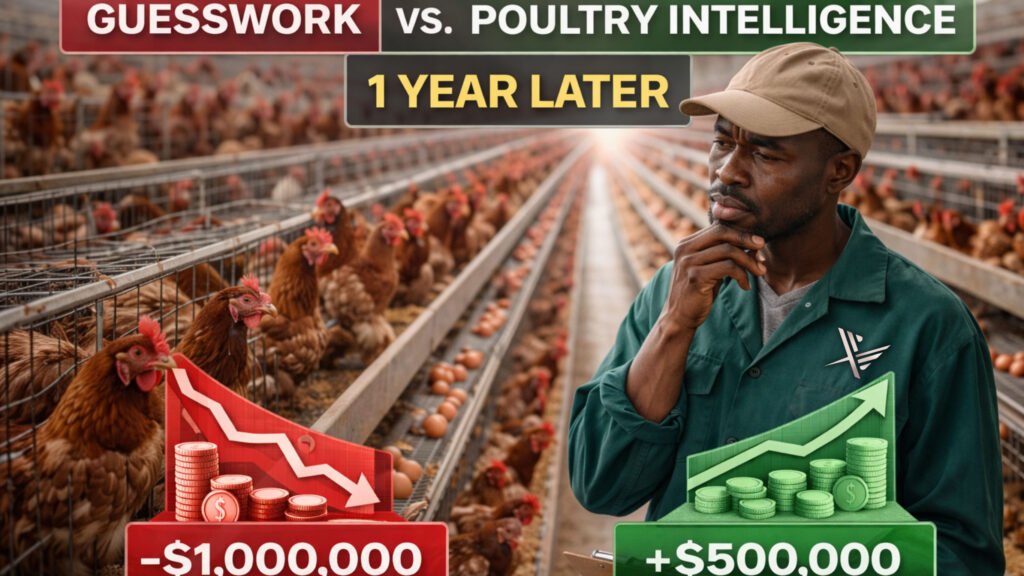
The Real Enemy Is Not Farmers. It Is Blind Decision-Making.
African poultry farming does not suffer from a talent problem. It suffers from a decision-making gap.
Farmers are forced to make high-stakes choices with incomplete information, under pressure, every day. When outcomes are good, it feels like skill. When outcomes are bad, it feels like bad luck.
Neither tells the full story.
What is missing is not more work, more discipline, or more sacrifice. What is missing is intelligence that reflects local realities and evolves with them.
The future of poultry farming in Africa will not be defined by bigger farms or more imported tools. It will be defined by whether farmers can replace guesswork with insight, intuition with evidence, and reaction with foresight.
In the weeks ahead, we will explore what that shift looks like, why existing tools have failed to deliver it, and how a new approach to poultry intelligence is beginning to emerge across the continent.
Because the real question is no longer whether guesswork is costly.
It is whether African poultry farming can afford to keep relying on it.